Container grades: what one trip, cargo worthy, IICL and as-is mean
Six labels carry a container's condition in Indian listings. New means no cargo yet and one trip one loaded voyage behind it, so near-new; IICL means repairs to the lessors' criteria; cargo worthy claims the box can still carry cargo; wind and water tight only that rain stays out; as-is that the damage comes with it. No law defines any of them, and only IICL rests on written criteria, the lessors'. None amounts to a valid CSC safety plate. In the Indian listings we read, writing "cargo worthy" barely moved the asking price of a used box, so judge the box, not the label.
Updated 17 Nov 2026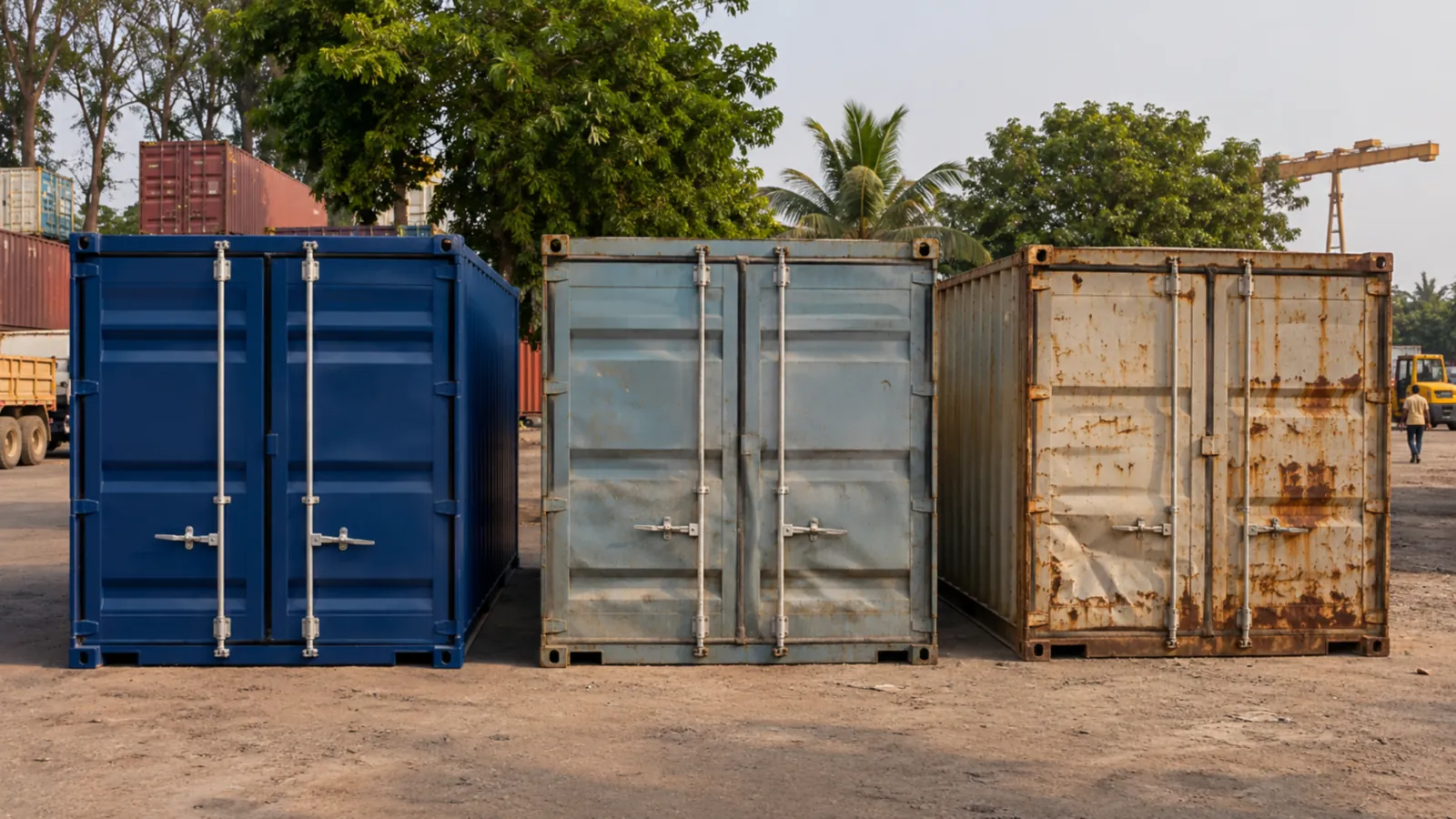
Container grades compared, with 20 ft asking prices
| Grade | Meaning | Defined by | Asking price, 20 ft |
|---|---|---|---|
| New | no cargo carried yet | the factory's papers | ₹2,25,000, middle of only 5 sellers |
| One trip | new, then loaded for one voyage, usually out of China | trade usage only | counted with new boxes here |
| IICL | repaired to the container lessors' inspection and repair criteria | criteria from the lessors' institute; label applied by the seller | not enough listings |
| Cargo worthy (CW) | fit for cargo, as judged by whoever inspected it | nobody officially | typically ₹1,20,000 (55 sellers) |
| Wind and water tight (WWT) | keeps out wind and rain; not for shipping | sellers alone | not enough listings |
| As-is | sold damaged, often where it stands | the seller | ₹75,000, middle of 3 sellers |
| No grade given | the majority of Indian listings | — | typically ₹1,20,000 (127 sellers) |
Asking prices on marketplaces, 15 November 2026, one figure per seller. "Typically" marks the median where at least 10 sellers asked; with fewer, the middle price is given with its seller count. Whatever the grade says, check the box and its CSC plate.
One trip container: what “1 trip” means
A one trip box, also sold as “1 trip” or “one tripper”, made its first voyage loaded with someone’s goods instead of travelling empty from the factory, usually in China, which builds nearly all of the world’s containers. Once unloaded, it goes on sale. Expect a near-new box, perhaps marked by a scrape or a dent from that single passage, and a CSC plate whose first examination falls due within five years of manufacture. Prices: new and one-trip 20 ft, 40 ft, 40 ft high cube.
What is a cargo worthy container?
On a listing, “cargo worthy” is the seller’s claim that the box could still take goods to sea: sound frame and floor, no holes, and doors that lock shut. The phrase has no official definition. A 2020 note from a marine insurer treats it as trade shorthand for whatever inspection standard each operator applies, and we came across no official “cargo worthy certificate”. The lessors’ institute adds a warning: the label says nothing about the CSC plate, so a box sold as cargo worthy may carry a plate whose examination date is already past. For a box that will carry goods abroad, get the seller’s cargo worthy statement in writing and see a CSC plate whose next examination date is still to come.
Cargo worthy or wind and water tight?
| Point | Wind and water tight | Cargo worthy |
|---|---|---|
| Promise | rain, wind and dust stay out | the same, plus strength to be stacked and to go to sea |
| Who defines it | only sellers: we found no definition from lessors, classification societies or standards, and one big supplier says no universal grading standard exists | nobody officially |
| Enough for | storage on your land, if the box is sound | shipping goods |
What IICL means on a used container
The Institute of International Container Lessors publishes the criteria, now in a sixth edition, for inspecting and repairing leased containers as they go out on lease and come back. “IICL” in a listing means the box was brought up to those criteria, usually by a leasing company before sale; one big lessor offers three levels when it sells: as-is, IICL, or certified cargo worthy.
The CSC plate behind any grade
India is a party to the Convention for Safe Containers, under which the CSC safety approval plate, normally on the left-hand door, is what lets a box travel internationally. It shows either:
| On the plate | What it means |
|---|---|
| A next examination date | the first comes no later than five years after manufacture, then at intervals of 30 months at most |
| ACEP | the owner’s approved continuous examination programme; it lapses once the box is sold out of that fleet, and the buyer must get an examination date stamped before the box sails again |
IMO guidance asks owners to take the plate off a box retired from service under the Convention. A box whose examination has run out can still store goods on the ground, but may not carry them by sea until examined again. The Indian Register of Shipping holds the government’s authorisation to certify containers in India: a surveyor inspects the box, stamps the next date on the plate and issues a certificate. No qualification is demanded of the person who extends a plate’s date, which is why you should ask who did the examination.
How often Indian listings name a grade
Sellers use the words freely and almost never back them with papers. Three readings show it:
| Reading | Result |
|---|---|
| Words counted in 858 listings on one marketplace, 20 October 2026 | “cargo worthy” 208 times, “wind and water tight” 10, “as-is” 7, “IICL” 4, “one trip” 2; the CSC plate, never |
| Asking prices by seller across marketplaces, 15 November 2026 | used 20 ft: typically ₹1,20,000 (55 sellers) when the listing says “cargo worthy”, ₹1,20,000 (127 sellers) when it names no grade; used 40 ft: ₹1,85,000 (34 sellers) against ₹1,75,000 (94 sellers). The word adds little or nothing to the price |
| Our smaller set of listings with an exact price, 20 October 2026 | the wording counted in the table below |
| Condition as the seller wrote it | Listings |
|---|---|
| Used, cargo-worthy | 6 |
| Used, wind and water tight | 2 |
| Used (no grade stated) | 41 |
| Used, as-is (damage declared) | 1 |
| One-trip | 1 |
| New | 3 |
Wording used by Indian sellers in the listings with an exact price that we read on 20 October 2026.
Which container grade do you need?
| Use | Grade to look for |
|---|---|
| Storage on the ground, a site store, a farm shed | wind and water tight, provided roof and floor are sound (used containers) |
| Office, shop or home | a one-trip box where looks matter, for instance a new 40 ft high cube; a sound used high cube graded cargo worthy costs less |
| Shipping goods, stacking | cargo worthy, with a CSC examination date still valid |
| A boundary wall, a frame for cladding, a store for scrap | as-is, after seeing the damage yourself (20 ft as-is, 40 ft as-is) |
How long does a container last?
Lessors plan on 13 to 14 years of sea service for dry boxes and 12 for reefers, and usually sell them at about 13 years old to depots, storage firms and freight forwarders. On land, no published figure exists that we could find: a box lasts as long as its roof, floor and doors are kept in repair.
Get these from the seller in writing
- What the grade means for this particular box, in the seller’s words.
- The container number, to match the doors against the invoice.
- If you will ship goods in it, a photo of the CSC plate showing the examination date or ACEP.
- Photos, or a video call, of the roof, floor and doors of that exact box; inspecting a used container lists what to look for.
- For a box that came in from abroad, the bill of entry clearing it for use in India (buying a used container from a yard).
Ask for the same five things when you request quotes.
Read next
Published 17 November 2026. Sources checked on 26 October 2026: the CSC convention with the IMO's guidance, the lessors' institute (IICL), a 2020 marine insurer's note, India's classification society, annual reports of two container lessors, trade press. Asking prices: marketplaces, 15 November 2026; word counts and exact-price listings: 20 October 2026.