How to inspect a used container before you pay
A listing tells you little; twenty minutes beside the box tell you a lot. Circle the frame, sight along the roof, work both doors, stand inside with them closed, walk the floor and read the CSC plate. Do this before paying, or have the seller show the same points on a live video call. Every step of this used container inspection rests on the international packing code for cargo units and on the damage limits that force a box out of service.
Updated 17 Nov 2026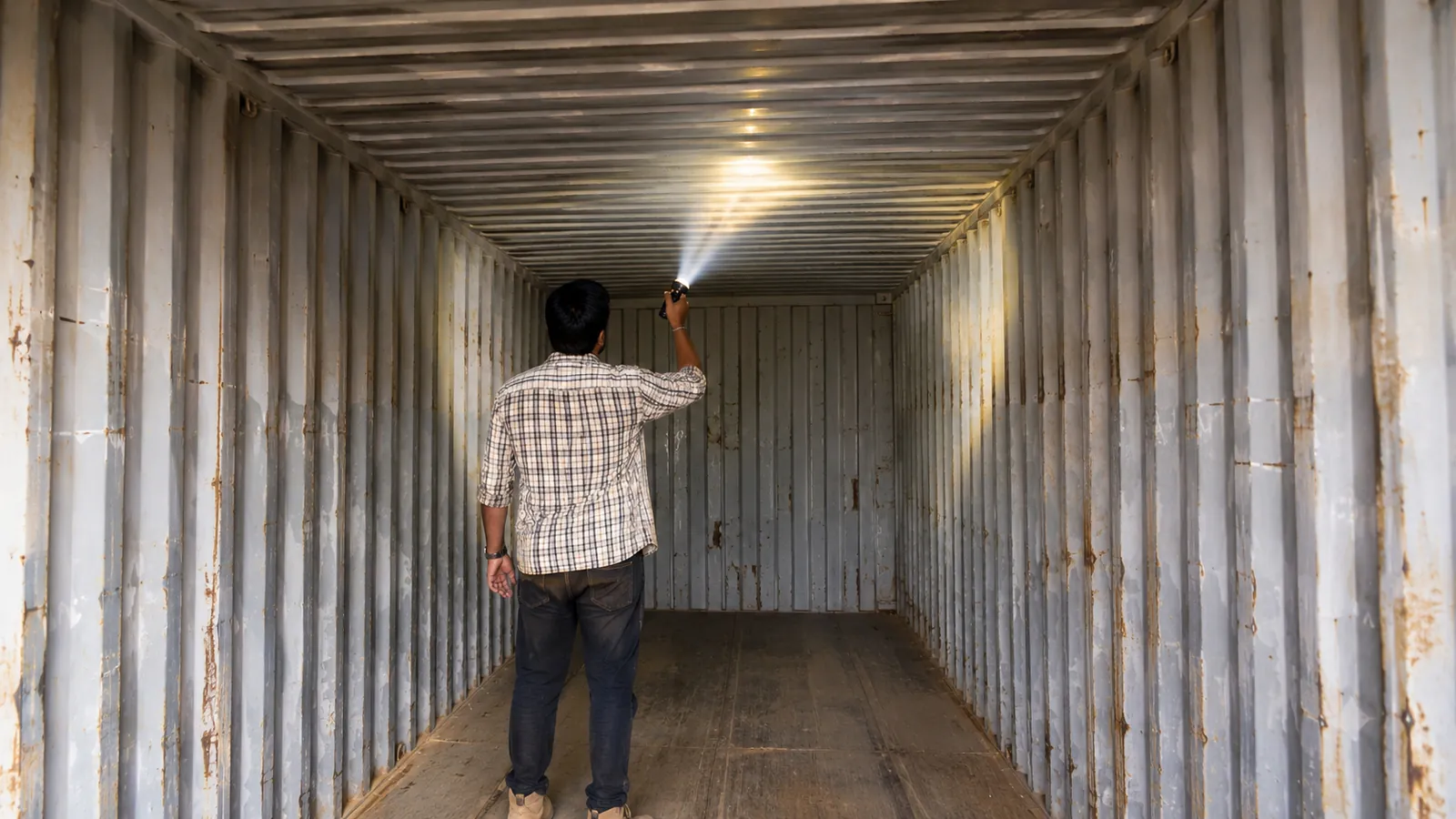
Before the visit: ask about one box, not the stock
Start with one question to the seller: which box, by its container number, would you deliver? Then ask for fresh pictures of that numbered box, not of the stock, or walk round it with the seller on a video call: the roof from above, the floor from the doorway, both doors open and then locked, the interior by daylight with both doors shut, and the CSC plate close enough to read. If you cannot make the trip, run the call with the checks below as your script.
Buying from photos or a call means taking care with the money. Look up the seller’s GSTIN with the taxpayer search on the GST portal, pay a registered business against a tax invoice into an account in its own name, and hold back part of the price until the box arrives and matches what you were shown. More on this: checking a container supplier.
Is it really a shipping container?
| A shipping container has | A cabin sold as a container usually has |
|---|---|
| an 11-character number on its doors, with a size-type code beside it: 22G1 (standard 20 ft), 42G1 (standard 40 ft), 45G1 (40 ft high cube) | no container number and no size-type code |
| a CSC plate on a door | no CSC plate |
| cast steel corner fittings at all eight corners | a frame of steel sections clad in panels |
| an outside width of exactly 2,438 mm (8 ft) | often a wider body: cabins are built 8 to 12 ft wide |
The last of the 11 characters is a check digit. Before you travel, type the number into the container number checker: a number that fails was misread, mistyped or made up, while one that passes only proves a valid format, so still match it against the box.
More on telling them apart: container vs porta cabin.
Outside: the frame first
The frame carries the load, so it deserves the first look; dented panels matter much less. Kneel by each corner casting and look for cracks or weld repairs, sight up each corner post for a bend, then follow the top and bottom rails from end to end.
| Part | What to look for |
|---|---|
| Corner castings and posts | no cracks, no weld repairs on the castings, posts straight (corner castings) |
| Top and bottom rails | straight end to end, no deep rust |
| Roof | sight along it from a ladder or higher ground: dents that hold water are where leaks begin |
| Panels | dents are normal; holes and rust right through are not, unless the box is sold as-is. Look hard at patches: rust streaks below a patch mean it leaks |
| Underneath, if the box is on blocks | the cross members under the floor, where rust cannot be seen from inside |
Defects that take a container out of service
Some defects, under the CSC convention and the rules of India’s classification society, put a box out of service on the spot until it is repaired. A few examples:
| Part | Limit |
|---|---|
| Top rail | deformed more than 60 mm |
| Corner post | deformed more than 50 mm |
| Corner casting | distorted more than 5 mm |
| Cross members | two adjacent ones missing |
| Door locking | an inner locking bar out of action |
Taken from the immediate out-of-service criteria in Annex III of the Convention for Safe Containers and the Indian Register of Shipping's 2021 notes on container certification. They govern whether a box may carry cargo; for a store on the ground, read them as a gauge of how bent it is.
The doors
A door that has to be forced shut usually means the box is standing out of level, so work both doors through their full swing before anything else: they should move freely and meet square. Turn every locking bar and check that it engages at both ends, top and bottom. Run a hand along the gaskets: they should be continuous and still soft, with no cracks or missing lengths. How container doors work names every part.
Inside
Open both doors and give the air time to change before you step in; the packing code advises it, and the fumigation section below explains why.
- Shut in, look up. On a bright day, ask someone to close the doors behind you: any pinpoint of daylight in the walls or roof is a hole. While your eyes adjust, check the walls for patches and rust streaks, and stand under the lowest dents in the roof.
- Underfoot. Cross the whole floor, slowly by the doorway, where forklift wheels turn: every board whole, no nail or bolt heads proud of the surface, no give underfoot.
- Gloved hand and nose. Wipe any stain with a glove: by the packing code, a stain that comes off on the glove is a reason to turn the box down for cargo. The box should be dry and clean, with no smell of mould, insects, seeds, soil or an old cargo.
Fumigation warnings
A box being fumigated carries a warning sign on its doors, at least 400 × 300 mm: “DANGER … UNDER FUMIGATION WITH … DO NOT ENTER”. Stay out: the gas is poisonous. A box without the sign may still hold gas, and tape across the gaskets or the vents is a clue; gas can go on leaking from the floor and the cargo for days after airing.
Has the floor been treated?
Container floors are often protected against insects: Australia’s quarantine rules call for permanently treated timber, and in plywood the insecticide goes into the glue between the plies. We found no official advice on such floors in homes, offices or food stores; for those uses, ask the seller how the floor was treated, and consider laying a new floor on top.
Reading the CSC plate
Usually fixed to the left-hand door, the CSC safety approval plate gives, in English or French:
| Line | Content |
|---|---|
| 1 | “CSC SAFETY APPROVAL”, the approving country and the approval reference |
| 2 | when it was built (month, year) |
| 3 | the box’s identification number given by the maker |
| 4 | maximum gross mass, kg and lbs |
| 5 | allowable stacking load, kg and lbs |
| 6 | transverse racking test force, in newtons (kg on older plates) |
| 7 | end and side wall strength, only where it differs from the standard |
| 8 | next examination date |
There is no tare on the plate; it is painted on the doors next to the maximum gross (container weight).
Instead of a date, a box in its owner’s continuous examination programme shows “ACEP” beside the plate, but the programme ends when the box is sold out of that fleet: a box you buy marked ACEP needs a fresh examination date before carrying cargo abroad. With no plate, or with a past date and no ACEP, a box may not be used in international or intermodal transport, though it can still serve as a store on the ground. The plate also dates the box, since it gives the build date, and with the tare from the doors gives what it may carry: maximum gross less tare. What the plate means for “cargo worthy” and the other labels: container grades.
Do shipping containers get inspected, and by whom?
Several people, for different reasons: examiners at the dates on the CSC plate if the box is to travel internationally, the packer before loading under the packing code, and some customs authorities with their own checks. None of them acts for you when you buy a box for your own land: the checks on this page are your job.
The 7 point container inspection, point by point
United States customs requires its trusted importers to check every empty container before packing, so nothing is hidden in the structure and no pests ride along. The seven points: front wall, left side, right side, floor, ceiling or roof, doors inside and out with their locks, and the outside and underside; on a reefer, the fan housing as well. It makes a sound order for your own walk round.
Hiring an expert in India
India’s classification society, the Indian Register of Shipping, carries out CSC examinations: a surveyor goes over the box inside and out, roof and underside included, may test its steel, then stamps a new date on the plate and writes a certificate. Inspectors certified by the container lessors’ institute also work in India; the institute’s list shows at least one. Surveyors licensed by India’s insurance regulator deal with insurance claims, not CSC plates. We found no published price for an inspection on a buyer’s behalf: ask for a quote, and for a written report.
Papers to get
- A tax invoice in your name, showing the container number and the GST treatment (GST on containers).
- For a box imported from abroad, the bill of entry that cleared it for use in India (buying a used container from a yard).
- Written delivery terms: who unloads, with what equipment, on what day (site preparation and unloading).
When you request quotes, ask each seller for the container number and photos of the box first.
Used container inspection checklist to take along
- Number on the doors = number on the invoice.
- Frame: corner castings and posts, rails, cross members, roof.
- Panels: patches, holes, rust that goes through.
- Doors: both swing and shut; bars lock; gaskets intact.
- No fumigation warning; box aired before going in.
- Light test with the doors closed.
- Floor: no broken boards, nails or soft spots; stains and smell checked.
- Photo of the CSC plate; for cargo abroad, an examination date still ahead (an ACEP mark ends with the sale).
- Paperwork: GSTIN looked up, invoice, delivery terms, and for an imported box its bill of entry.
Read next
Published 17 November 2026. Sources checked on 26 October 2026: the CSC convention; the 2014 international packing code for cargo transport units (IMO, ILO, UNECE); the Indian Register of Shipping; US customs' security criteria (2019); Australia's 2005 quarantine rules for containers; the container lessors' institute.