Shipping container sizes and dimensions
A 20 ft container gives 33.2 m³ inside (5,900 × 2,352 × 2,393 mm) and weighs about 2,230 kg empty; a 40 ft gives 67.7 m³ over a length of 12,192 mm, against 6,058 mm. Whatever the length, 10, 20, 40 or 45 ft, an ISO box is 8 ft (2.438 m) wide and 8 ft 6 in (2.591 m) tall, or 9 ft 6 in (2.896 m) as a high cube. The tables cover 17 types; each figure is the median of the data sheets that makers and shipping lines publish.
Updated 17 Nov 2026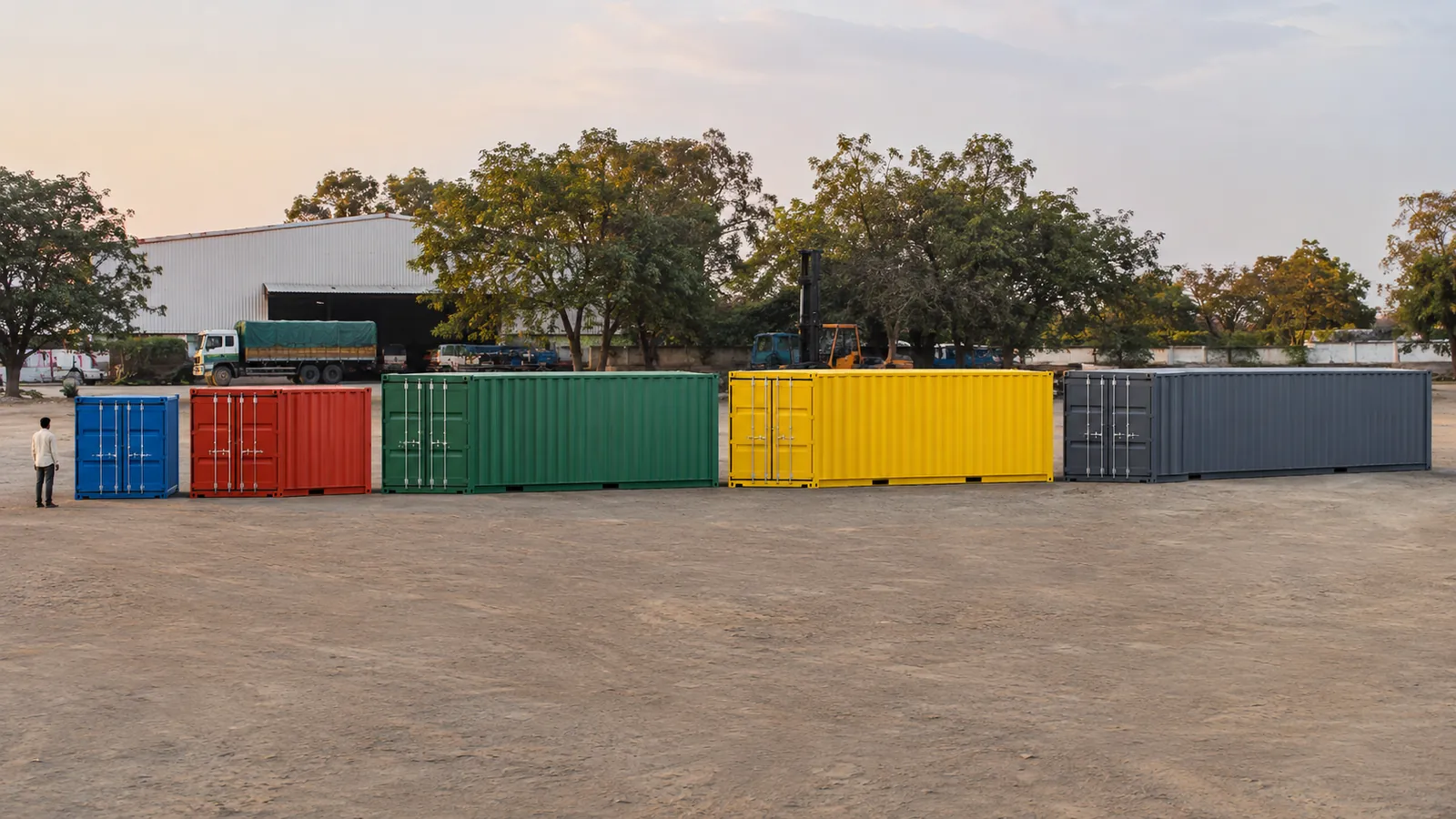
Standard container sizes outside, in metres and feet
| Box | Code | Length | Width | Height |
|---|---|---|---|---|
| 10 ft container | 12G1 | 2.991 m (9′ 10″) | 2.438 m (8′) | 2.591 m (8′ 6″) |
| 20 ft standard container | 22G1 | 6.058 m (19′ 10½″) | 2.438 m (8′) | 2.591 m (8′ 6″) |
| 20 ft high cube container | 25G1 | 6.058 m (19′ 10½″) | 2.438 m (8′) | 2.896 m (9′ 6″) |
| 40 ft standard container | 42G1 | 12.192 m (40′) | 2.438 m (8′) | 2.591 m (8′ 6″) |
| 40 ft high cube container | 45G1 | 12.192 m (40′) | 2.438 m (8′) | 2.896 m (9′ 6″) |
| 45 ft high cube container | L5G1 or 55G1 | 13.716 m (45′) | 2.438 m (8′) | 2.896 m (9′ 6″) |
Metres first, then feet and inches to the nearest ½ inch (ISO 668 states the 10 ft as 9 ft 9¾ in long). Medians of data sheets read on 20 October 2026. Length and width follow ISO 668; the 10 ft's height follows the sheets, since the standard lists that box 8 ft high. Codes are decoded further down. A reefer, open top, flat rack, open side or double door box has the same outside size as a dry box of its length and height.
Container width and height: standard box or high cube
| Measure | Standard box | High cube |
|---|---|---|
| Width | 2,438 mm (8 ft), at every length | the same |
| Height | 8 ft 6 in, or 2,591 mm | 9 ft 6 in, or 2,896 mm: a foot more, marked HC or HQ |
ISO 668, the standard behind these sizes, also has boxes of 8 ft and less in height, among them the half height container at 1,295 mm (4 ft 3 in), made for heavy loads like ore or scrap; our tables leave those out. The common sizes have a guide each: 20 ft container size, 40 ft container size, 40 ft high cube dimensions.
Container lengths: 10, 20, 40 and 45 ft
| Length | Outside | Note |
|---|---|---|
| 10 ft | 2,991 mm | the shortest length in ISO 668 |
| 20 ft | 6,058 mm | 38 mm less than 6,096 mm, a true 20 ft |
| 40 ft | 12,192 mm | a true 40 ft |
| 45 ft | 13,716 mm | high cubes in our tables (45 ft container) |
The odd 6,058 mm of a “20 ft” is deliberate. Ships, wagons and stacks are laid out in 40 ft slots of 12,192 mm: two 20 ft boxes fill one with 76 mm between them, four 10 ft boxes with three such gaps fill another, and the corner fittings of every box then sit over those below. ISO 668 also lists a 30 ft length, which our tables leave out. By road, a 45 ft needs the longer rig India allowed in 2020, when rule 93 of the Central Motor Vehicles Rules took a tractor with semi-trailer from 18 m to 18.75 m.
Smallest container size: the 10 ft
At 2,991 mm, the 10 ft is the shortest length in ISO 668, which pairs it with a height of 8 ft or less. The 10 ft boxes on the sheets we read are taller, 8 ft 6 in, and coded 12G1, a pairing the standard does not list. Shorter boxes, of 8 or 6 ft, are built outside the ISO sizes and carry no length code. What a used one costs: used 10 ft container.
How tall on a truck in India
With an ISO container on board, a vehicle may be 4.52 m high in all, against 4 m for other loads (rule 93, amended 2020). Carrying a 2,896 mm high cube, that leaves a trailer deck of about 1.6 m above the road at most. Gates, overhead cables and bridges on the way in need checking: site preparation and unloading.
Container internal dimensions, doors and capacity
| Box | Inside, mm (L × W × H) | Door, mm (W × H) | CBM | Empty, kg | Gross rating, kg | Payload, kg |
|---|---|---|---|---|---|---|
| 10 ft container | 2,831 × 2,350 × 2,392 | 2,340 × 2,280 | 15.9 m³ | 1,300 kg | 10,160–12,000 kg | 8,960 kg |
| 20 ft standard container | 5,900 × 2,352 × 2,393 | 2,340 × 2,280 | 33.2 m³ | 2,230 kg | 30,480–32,500 kg | 28,260 kg |
| 20 ft high cube container | 5,898 × 2,352 × 2,698 | 2,340 × 2,585 | 37.4 m³ | 2,230 kg | 30,480 kg | 28,250 kg |
| 40 ft standard container | 12,032 × 2,352 × 2,393 | 2,340 × 2,280 | 67.7 m³ | 3,700 kg | 30,480–32,500 kg | 28,780 kg |
| 40 ft high cube container | 12,032 × 2,351 × 2,698 | 2,340 × 2,585 | 76.4 m³ | 3,865 kg | 30,480–32,500 kg | 28,655 kg |
| 45 ft high cube container | 13,556 × 2,352 × 2,699 | 2,340 × 2,585 | 86 m³ | 4,750 kg | 30,480–32,500 kg | 27,675 kg |
Sources: median of the sheets of CMA CGM, Evergreen, Hapag-Lloyd, Maersk, MSC, ONE and ZIM; 10 ft and 20 ft HC: sheets from makers, sellers and lessors, read on 20 October 2026. CBM is the median of the volumes the sheets print, so it need not equal length × width × height; the gross rating column spans the lowest to highest rating; payload is the sheets' median. 20 ft HC: a single sheet. For a particular box, its doors carry its tare and gross rating, and its CSC plate the rating again.
Walls, floor and roof take their share, so the inside is smaller than the outside, and the door is smaller again (door dimensions): 2,340 × 2,280 mm on a standard box, 2,585 mm high on a high cube. Measure your tallest item against the door, not against the inside height.
| Box | Volume | Euro pallets on the floor | Payload |
|---|---|---|---|
| 20 ft | 33.2 m³ | 11 | 28,260 kg |
| 40 ft | 67.7 m³ | 23 | 28,780 kg |
| 40 ft high cube | 76.4 m³ | the same floor as a 40 ft | about the same as a 40 ft |
You may see 5,867 × 2,330 × 2,350 mm quoted for the inside of a 20 ft, with a 2,286 × 2,261 mm door. Those are the smallest sizes ISO 668 permits, not what a typical box offers: across the 9 data sheets we read, the median inside is 5,900 × 2,352 × 2,393 mm.
Weight of each size
| Term | What it is | Figures |
|---|---|---|
| Tare | the box empty; it decides which crane or side-lifter unloads it | 20 ft: 2,230 kg typical, 2,120–2,350 kg across data sheets; 40 ft: 3,700 kg; 40 ft high cube: 3,865 kg |
| Maximum gross | box and load together; shown on the CSC plate and painted on the doors next to the tare | since its 2022 amendment, ISO 668 allows up to 36,000 kg for every size except the 10 ft (10,160 kg); the 20 ft data sheets give 30,480 or 32,500 kg |
| Payload | maximum gross minus tare, often painted on the doors as well | 28,260 kg for a typical 20 ft |
Flat racks break the pattern: made for machinery, some carry ratings well above the ISO figure, up to 58,600 kg on the sheets we read, which an ordinary semi-trailer cannot take. Before a packed box boards a ship, the shipper must declare its verified gross mass (VGM); on Indian roads, tractor, semi-trailer and load together may not pass 55 tonnes. Every type’s weights, a container-number check and a VGM calculator: container weight.
Types of container and their sizes
| Type | What it is | Guide |
|---|---|---|
| Standard or dry (20 GP, 40 GP) | the common closed steel box with end doors | 20 ft, 40 ft |
| High cube | a foot taller: 76.4 m³ in a 40 ft; rare in 20 ft | 40 ft high cube |
| Reefer | insulated, with a cooling unit at one end | reefer container |
| Open top | a tarpaulin roof that comes off, for loads lowered by crane | open top dimensions |
| Flat rack | a floor with end walls (folding on some) for machinery and loads too big for a box | flat rack dimensions |
| Box | Inside, mm (L × W × H) | Door, mm (W × H) | CBM | Empty, kg | Gross rating, kg | Payload, kg |
|---|---|---|---|---|---|---|
| 20 ft reefer container | 5,456 × 2,290 × 2,180 | 2,290 × 2,252 | 28.2 m³ | 2,920 kg | 30,480–32,000 kg | 27,520 kg |
| 40 ft high cube reefer container | 11,589 × 2,290 × 2,450 | 2,290 × 2,557 | 67.5 m³ | 4,505 kg | 34,000–35,000 kg | 29,610 kg |
| 20 ft open top container | 5,898 × 2,351 × 2,348 | 2,340 × 2,280 | 32.5 m³ | 2,245 kg | 30,480–32,500 kg | 28,260 kg |
| 40 ft open top container | 12,029 × 2,350 × 2,348 | 2,340 × 2,278 | 66.3 m³ | 3,880 kg | 30,480–32,500 kg | 26,600 kg |
| 40 ft high cube open top | 12,032 × 2,352 × 2,653 | 2,340 × 2,585 | 75.1 m³ | 3,915 kg | 30,480–32,500 kg | 28,505 kg |
| 20 ft flat rack | 5,634 × 2,194 × 2,213 | — | — | 2,890 kg | 34,000–45,000 kg | 31,250 kg |
| 40 ft flat rack | 11,657 × 2,298 × 1,955 | — | — | 5,025 kg | 45,000–52,500 kg | 40,075 kg |
| 40 ft high cube flat rack | 11,652 × 2,374 × 2,264 | — | — | 5,300 kg | 50,000–58,600 kg | 47,300 kg |
| 20 ft open side container | 5,898 × 2,287 × 2,299 | 2,170 × 2,169 | 31 m³ | 3,190 kg | 24,000–30,480 kg | 20,820 kg |
| 20 ft double door container | 5,844 × 2,352 × 2,394 | 2,342 × 2,280 | 32.9 m³ | 2,277 kg | 30,480 kg | 28,203 kg |
| 40 ft double door container | 11,978 × 2,352 × 2,393 | 2,340 × 2,280 | 67.4 m³ | 3,580 kg | 30,480 kg | 26,900 kg |
Sources: median of the sheets of CMA CGM, Evergreen, Hapag-Lloyd, Maersk, MSC, ONE and ZIM; 20 ft open side, 20 ft double door and 40 ft double door: sheets from makers, sellers and lessors, read on 20 October 2026. CBM is the median of the volumes the sheets print, so it need not equal length × width × height; the gross rating column spans the lowest to highest rating; payload is the sheets' median. For a particular box, its doors carry its tare and gross rating, and its CSC plate the rating again. For flat racks, inside means the deck between the end walls.
Side doors, or doors at both ends
On an open side container, doors run along one long side as well as at the end, so pallets can go in sideways. On the 20 ft data sheets we read, the side opening measures roughly 5.7–5.8 m by 2.15–2.19 m (length by height); the end door is 2,170 × 2,169 mm; the extra doors bring a 20 ft to 3,190 kg empty. The double door container, also called a tunnel container, opens at both ends, so goods can go in one end and out the other, with almost a standard box’s room inside: 32.9 m³ for a 20 ft.
Reading the type code: 22G1, 42G1, 45G1
ISO 6346 sets the four characters painted beside the container number:
| Position | Tells you | Values |
|---|---|---|
| First | length | 1 = 10 ft, 2 = 20 ft, 4 = 40 ft, L = 45 ft; under the 2022 edition the code registrar issues 5 for 45 ft, and boxes marked earlier keep their code |
| Second | height | 0 = 8 ft, 2 = 8 ft 6 in, 5 = 9 ft 6 in |
| Third and fourth | type | G = general purpose (G1 vented, G2 or G3 with side openings), R = reefer, U = open top, P = flat rack |
Examples: 22G1 means a 20 ft standard box; 42G1, its 40 ft equivalent; 45G1, a 40 ft high cube, not a 45 ft; L5G1, a 45 ft high cube. Where to find the code and the CSC plate on a box: inspecting a used container.
TEU container: what one TEU counts
The unit of count at ports and shipping lines is the TEU (twenty-foot equivalent unit): 1 for a 20 ft; a 40 ft, high cube or not, is 2 TEU, also called one FEU. A 45 ft, or any box longer than 40 ft, counts as 2.25 TEU in the glossary the EU uses for transport statistics.
20 ft or 40 ft?
Room doubles, carrying capacity does not: 67.7 m³ against 33.2 m³, yet a typical 40 ft takes 28,780 kg and a 20 ft 28,260 kg. Bought used, space costs less in the long box: about ₹2,700 per m³ inside, against ₹3,600 for a 20 ft, at the typical asking prices of 15 November 2026. The 20 ft keeps the edge for dense goods and for lanes or plots too tight for a 12 m box on its trailer; 20 ft against 40 ft sets them side by side.
Prices by size
| Box | From | Typical | Sellers |
|---|---|---|---|
| 20 ft shipping container, used (second hand) | ₹1,00,000 | ₹1,20,000 | 172 |
| 40 ft shipping container, used (second hand) | ₹1,60,000 | ₹1,80,000 | 123 |
| 40 ft high cube container (40 HC), used | ₹1,58,000 | ₹1,90,000 | 37 |
| 20 ft high cube container, used | ₹1,25,000 | — | 8 |
| 20 ft container, new one-trip | ₹2,25,000 | — | 5 |
| 40 ft container, new one-trip | ₹3,45,000 (lower of 2 asks) | — | 2 · thin market |
| 40 ft high cube container, new one-trip | ₹2,95,000 | — | 4 · thin market |
Rows marked thin market rest on so few sellers that one box can look cheaper than a better one: compare them only on quotes for the same delivery.
These are prices from our reading of 15 November 2026, before delivery: “From” sits near the low end of what sellers ask, “Typical” is their median, and most listings are silent on GST. Container Bhav sells nothing itself; partner sellers answer quote requests. Container price goes through each size and condition.
Size guides and container prices
Published 17 November 2026. Sizes and weights: the data sheets cited under each table, read on 20 October 2026. Prices: marketplace asking prices read on 15 November 2026; listings with an exact price read on 20 October 2026.