Customs duty on a shipping container in India: rates, bonds, papers
Customs duty on a shipping container kept in India adds up to about 31% of its customs value (24.5% for a reefer): 10% basic customs duty (5% on a reefer), plus a social welfare surcharge worth 10% of the customs duty, then 18% IGST on the value plus both. A GST-registered business that recovers the IGST is left with 11% (5.5% for a reefer). A box that just delivers cargo pays nothing, under a bond that commits it to leave again within 6 months.
Updated 17 Nov 2026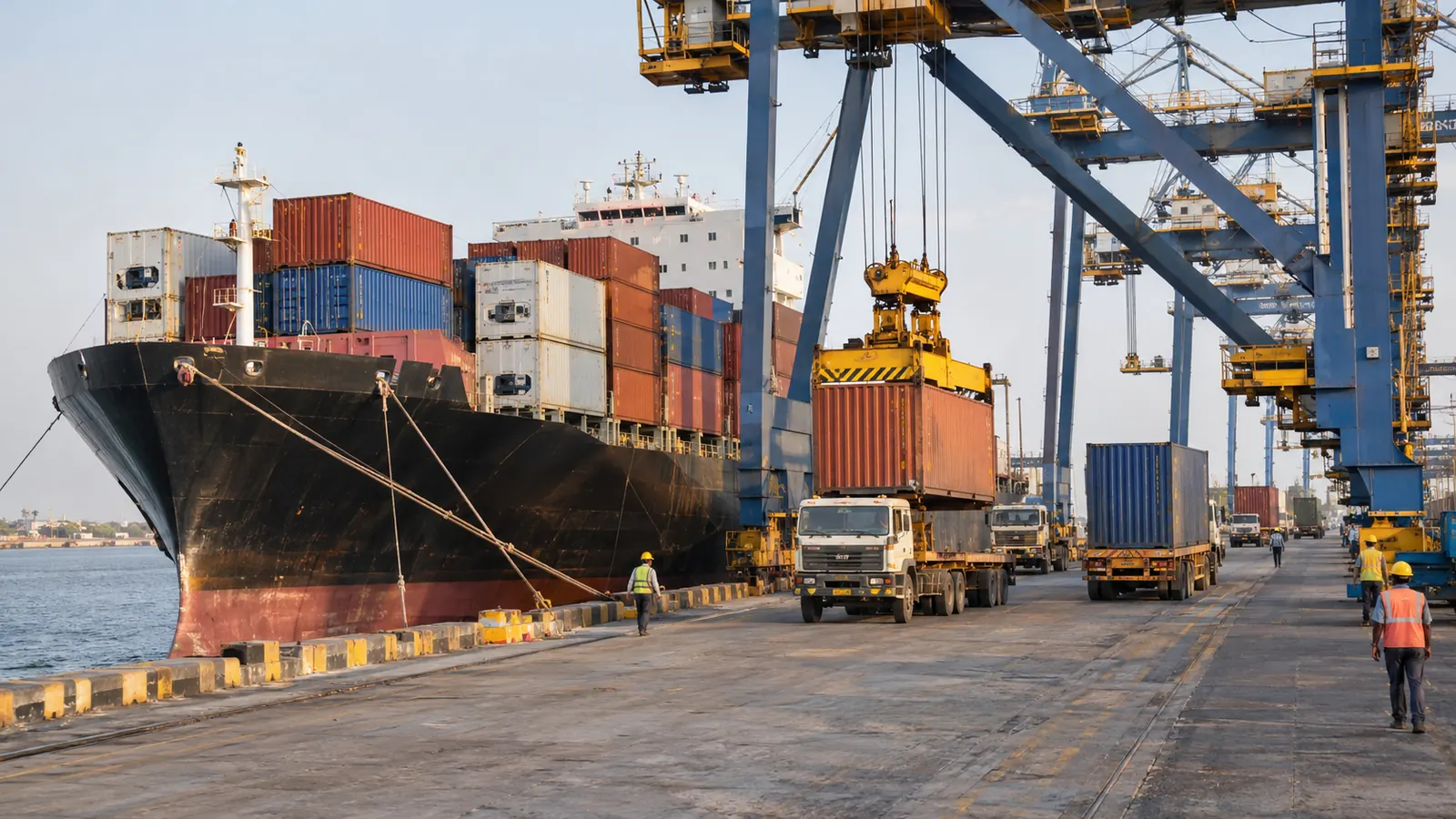
Basic duty, surcharge and IGST, layer by layer
An example per ₹1 lakh of customs value (a worked figure, not a price):
| For ₹1 lakh of customs value | Basic duty | Surcharge (SWS) | IGST | Altogether |
|---|---|---|---|---|
| Dry box, standard or high cube (8609 00 90) | ₹10,000 (10%) | ₹1,000 | ₹19,980 | ₹30,980 (30.98%) |
| Reefer (8609 00 10) | ₹5,000 (5%) | ₹500 | ₹18,990 | ₹24,490 (24.49%) |
Each layer sits on the one before. For a dry box worth ₹1,00,000 at customs:
| Step | Rate and base | Amount |
|---|---|---|
| 1. Basic customs duty (BCD) | value × 10% | ₹10,000 |
| 2. Social welfare surcharge (SWS) | BCD × 10%, not the value; not levied on IGST, and we found no container exemption | ₹1,000 |
| 3. IGST | 18% of value + duty + surcharge (₹1,11,000) | ₹19,980 |
| Total | 30.98% of the value | ₹30,980 |
We looked for other charges on containers and found none: their agriculture infrastructure cess is nil, and they carry no safeguard, countervailing or anti-dumping duty. The rates applied are those in force when the bill of entry is filed; a bill filed before the ship arrives takes the rates of the day it enters port.
Container customs duty calculator
Type your box’s customs value in rupees and pick its type:
₹30,980
30.98% of the value in duty and IGST; ₹11,000 remains a cost once the IGST is recovered as input tax credit.
Computed on the value you type: basic duty at 10% or 5%, surcharge at 10% of that duty, then IGST at 18% on value + duty + surcharge, each rounded to the rupee. An illustration, not a quote: customs sets the value, and port, broker and trucking charges are extra.
Getting the IGST back
If you hold a GST registration and the box serves your business, the IGST normally comes back as input tax credit, just like GST on a domestic purchase (GST and HSN code of containers). Duty and surcharge are another matter: they are not GST, no credit offsets them, and they stay in your cost, 11% of the value on a dry box, 5.5% on a reefer. Without a registration, the whole 30.98% is yours to bear.
Which value is taxed?
The CIF value, as section 14 of the Customs Act defines it: what you paid for the box, plus freight and insurance up to the Indian port. Customs stopped adding 1% for landing charges on 26 September 2017. What you spend after the box lands (terminal, broker, trucking) is outside that value, but it is still part of what the box costs you, so put it in your landed cost.
What the new 2026 customs rules change for containers
Two tariff items have replaced one under heading 8609 since 1 May 2026, under the Finance Act 2026: 8609 00 10, refrigerated containers, now at 5%, and 8609 00 90, every other container, at 10%. In practice the duty did not move, because an exemption already held reefers at 5%. On 1 February 2026 the Budget speech also announced a scheme to build containers in India, container scanning at the major ports and, within two years, a new customs IT system: announcements so far, not rules an importer must follow.
Boxes that come in with cargo: temporary admission
Most containers arriving in India are only there to deliver goods. A durable container, a shipping line’s box for instance, comes in without duty or IGST under a bond to take it out again within 6 months, a period customs can extend for sufficient cause (entry 414 of Notification 45/2025-Customs, applicable since 1 November 2025). Customs now tracks on ICEGATE every box not re-exported within 6 months, and shipping lines furnish a continuity bond without any bank guarantee: that is what a copy of a CBIC circular dated 11 July 2026 says. A box that is neither re-exported nor cleared lets customs enforce the bond for the duty plus interest, and a penalty can follow; the Nhava Sheva customs house told the trade so again in July 2026.
Boxes that stay: home consumption
Buy a box abroad to sell, use or convert here, and it must be cleared for home consumption: bill of entry, then duty and IGST as above. On boxes that came in under bond, we found only a local text: a public notice issued in 2008 by the Nhava Sheva customs house, about boxes leased one way to India, which requires them to be cleared for home consumption, with duty paid, before any use in India. No national circular on selling retired boxes within India turned up.
Buying an imported box already in India
Nearly every used or one-trip box on sale here was built abroad. Before paying, get the bill of entry that cleared it (its number and date, or a copy) plus a GST tax invoice: a box still bonded to a shipping line has not been cleared for Indian use. The rest of the purchase: buying from a container yard, container grades.
Are used containers allowed in?
Yes. In the DGFT’s import policy, ITC(HS), both container tariff items are free, and a condition of chapter 86 adds that second-hand marine containers fall under the heading and are free to import. That condition matters: without it, paragraph 2.31 of the Foreign Trade Policy 2023 would apply, under which used goods are restricted unless they are capital goods. Its text still cites 8609 00 00, the line used until April 2026, so ask your customs broker to check how it applies to your boxes before you place an order.
SIMS registration before the box arrives
A second condition of chapter 86 applies to all its imports, containers among them: each must be registered online, before it arrives, in the Steel Import Monitoring System (SIMS) run by the DGFT. Fees and deadlines: your broker, or the SIMS portal.
Documents to import a container
| Document | When you need it |
|---|---|
| Importer-Exporter Code (IEC), from the DGFT | for every import, except an individual’s import for personal use unconnected with trade, manufacture or farming; a box for a shop, an office or company storage is connected with trade |
| Bill of entry | always: the customs declaration, lodged online (usually by your broker) with the invoice and shipping papers |
| SIMS number | always for containers: it proves the SIMS registration described above |
| Certificate of origin | needed only when a trade agreement would lower the duty |
Import a container or buy one in India?
For one box or a handful, start from Indian prices: a box on sale here should already have been cleared, duty paid. On 15 November 2026 a used 20 ft typically asked ₹1,20,000 and a used 40 ft ₹1,80,000; new or one-trip 20 ft boxes were listed from ₹2,25,000, by 5 sellers, GST not added (container prices in India). To the price paid abroad, an import adds ocean freight, 11% in duty and surcharge that nobody gets back, port and broker charges, and a truck from the port (delivery costs). The IGST does not tip the balance: a registered business recovers it whether the box is imported or bought here. Most containers are built in China, and a box from there pays the same rates as any other. Importing can make sense for a batch of new boxes built to your own specification; a few Indian factories build ISO containers too, and shipping container manufacturers in India lists the ones we could check.
Buying a box that is already here? A quote request with your PIN code goes to partner sellers who cover it; ask each one for the bill of entry.
Read next
Published 17 November 2026. Law checked on 26 October 2026: Finance Act 2026, Customs Act, CGST Act, customs and DGFT notifications, a July 2026 CBIC circular, Nhava Sheva customs public notices, Foreign Trade Policy 2023. Prices: asking prices read on 15 November 2026.