Preparing the site: container foundation and unloading
Before the truck comes, two things must be ready: a container foundation under the four lower corner castings, which carry the whole box, and a clear way in. For storage, four concrete piers are enough, level with one another and high enough to stay out of flood water: about ₹6,800 of concrete on CPWD's 2023 rate, by our arithmetic, plus digging. To lift the box down, a crane on that 2023 schedule costs about ₹5,050 per 8-hour day, with GST, the operator's margin and travel to site on top. Walk the route before booking the truck: access causes most delivery trouble.
Updated 17 Nov 2026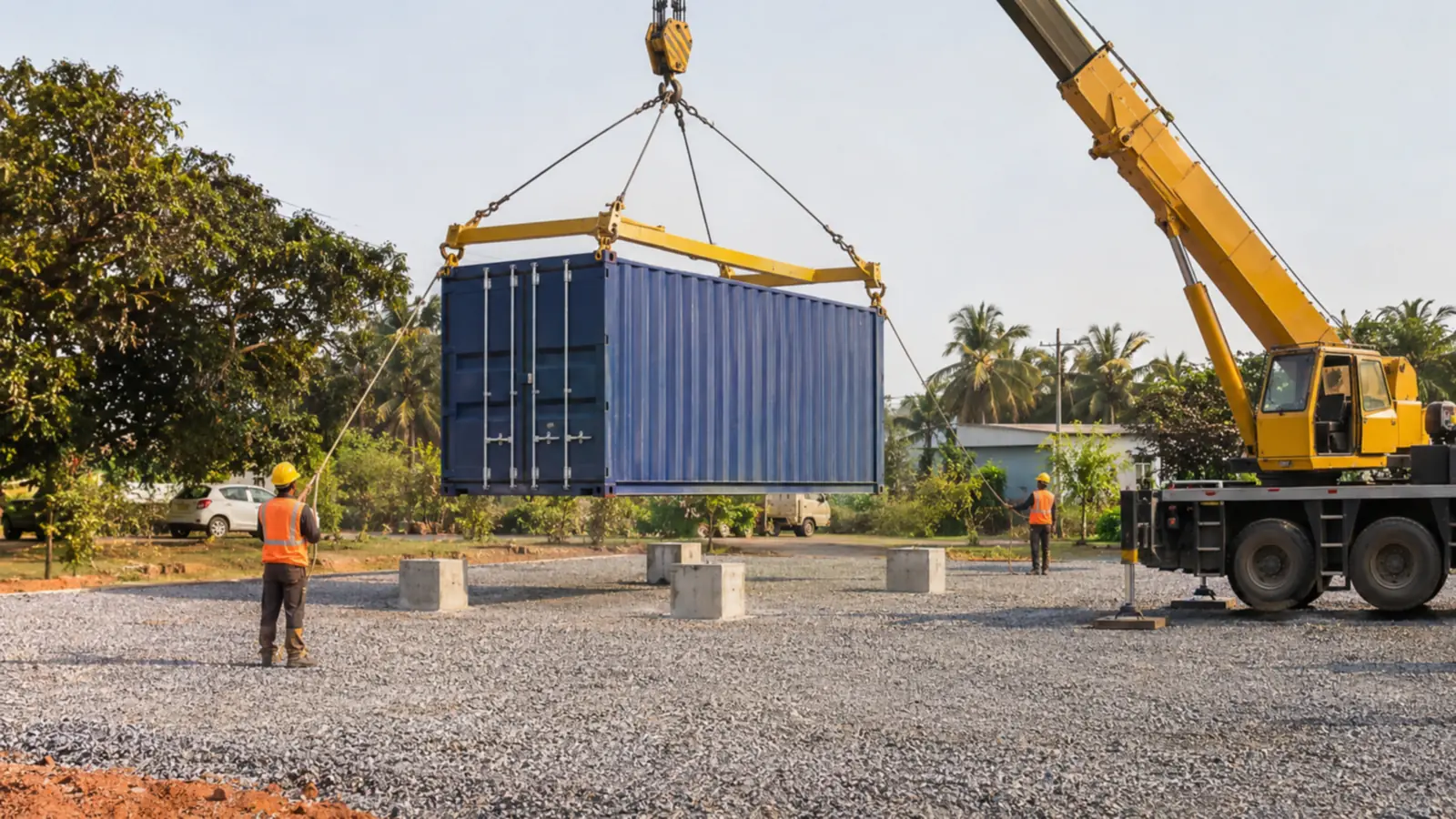
What a container stands on
Four steel castings, one at each lower corner, are all a container needs to stand on: ISO 1496-1, the general cargo container standard, builds the box for exactly that, with the underside of its base 12.5 mm higher than the castings’ bottom faces. The beams under the floor (the bottom cross members) may share the load; the bottom side rails along each side may not. Set straight on soft or uneven soil, the box beds in and twists: the international packing code warns that it takes the shape of the ground, its doors jam, and it keeps sinking. Doors knocked out of line usually come back into true once one corner is packed up with a shim, a thin plate of steel.
Container foundation types and cost: piers, blocks, pads, slab
| Use | Base | Notes |
|---|---|---|
| Storage | a level support at each corner (four, even under a 40 ft), on firm ground that drains: piers, pads or solid blocks of concrete, or a plinth | each pier, a 600 mm cube of plain concrete (0.216 m³), works out at about ₹1,700 at ₹7,879 per m³, CPWD’s 2023 rate with GST and the contractor’s margin included; four of them come to about ₹6,800 by our arithmetic, before digging and formwork. The corner plan above marks where each pier goes |
| A long stay, an office, a home | a foundation an engineer designs, anchoring the box | any intermediate supports belong under cross members, not side rails, and must be 12.5 mm taller than the corner supports (or shimmed), since that is how far the base sits above the corners. Corner centres are 2,259 mm apart across the box and 5,853 mm (20 ft) or 11,985 mm (40 ft) along it (twist locks and corner castings, which also covers anchoring) |
| Several boxes as one building | a slab | drain around it, so rain does not lie under the floor |
How deep each pier goes depends on the soil: ask a local engineer or mason who knows the ground. Piers, crane and haulage are all counted in the container house cost guide.
How high off the ground?
The 2016 Model Building Bye-Laws want a plinth at least 450 mm above the surrounding ground, with drainage; states adapt them, so ask your local body (permission to place a container). Air moving under a raised floor also slows rust.
Container house on stilts in flood zones
Where floods come, the NDMA’s guidelines set a building’s plinth 0.6 m higher than the flood or submersion line. They allow homes on stilts within the 25-year flood zone, never within the 10-year one. The packing code, for its part, advises raising a box on blocks wherever water may reach it. Piers or columns that tall become a structure of their own: they need an engineer’s design, and the box must be anchored to them.
Termites
The floor of a container is timber. IS 6313 (Part 2), India’s standard against subterranean termites, treats the soil under a building with chemicals; for a container, keep at least the floor off the soil and the gap beneath it open to the air.
Getting the truck in
| Limit | What to check |
|---|---|
| Height | rule 93 of the Central Motor Vehicles Rules allows 4.52 m overall with an ISO container on board: look up for wires, branches, gate arches and balconies along the way |
| Length | a tractor and semi-trailer may measure 18.75 m. A 40 ft trailer needs a wide, straight approach; a 20 ft turns more easily. No Indian rule on turning circles turned up, so walk the route with the transporter’s dimensions |
| Ground | a loaded trailer, side-lifter legs and crane outriggers all bear down hard; a wet field can stop everything |
Unloading a container: four methods compared
| Method | Site needs | Which boxes | Worth knowing |
|---|---|---|---|
| Side-lifter | firm, level ground right next to the trailer; one maker wants 5–6 m clear alongside, and by our count trailer and box side by side need about 6.4 m; nothing overhead | a 20 ft, a 40 ft, or two 20 ft | one maker's 36 tonne unit reaches 3.9 m, setting the box down on the ground or onto another truck, with no crane to hire |
| Mobile crane | space for the crane close by, firm ground beneath it, a clear swing | all | reaches over walls or up to a raised base; public rates: ₹5,050 per day in CPWD's 2023 schedule, ₹600 per hour for a 10 tonne unit in Tamil Nadu's for 2024-25, both before GST |
| Forklift | hard, level ground; forks that go 1,825 mm into the pockets | 10 ft and 20 ft only, by their fork pockets | 40 ft boxes have no pockets: never lift one on forks |
| Tilt trailer | depends on the transporter | depends on the transporter | the deck tips and the box slides off; we found no maker data and no Indian rate |
Side-lifter figures: two makers' data sheets; 6.4 m is our sum of half the trailer's width, the reach and half the box's width. Crane: public schedules of rates. Forklift: ISO 1496-1 and the packing code.
Can a forklift lift a 20 ft container? Fork pocket dimensions
Possible if the box has fork pockets, which ISO 1496-1 permits only on 20 ft and 10 ft boxes. The main pair, centred 2,050 mm apart (±50 mm), each at least 355 mm wide and 115 mm high, is for a loaded or empty box; some boxes add an inner pair 900 mm apart, for empty boxes only. Forks must enter at least 1,825 mm. A 40 ft has no pockets, and no box without them should go on forks. Check with the forklift’s owner that it is rated for the weight at that reach: an empty 20 ft is about 2,230 kg.
Side lifter or side loader trailer
A side-lifter (or side loader) is a trailer with its own cranes, which lifts the box off its deck and lowers it beside the road or onto another truck. No crane hire, but the spot has to be right beside where the truck stands, on firm ground with little slope; one maker sets 2° as the limit. We found no side-lifter operator documented in India, so ask the seller whether one works in your area.
Tilt tray container delivery and tilt trailers
The deck tips back and the box slides onto the ground behind. With no maker data or Indian rate found, ask any seller who offers one what approach and ground it needs, and whether the box’s rear corners will drag across your ground or your supports.
Crane unloading rates and Hydra capacity
Pick-and-carry “Hydra” cranes, which travel with their load, are common on Indian sites, but what they can hold shrinks quickly as the boom reaches out: a 12 tonne model from one maker manages its full 12 tonnes only 1.7 m out, and 2.3 tonnes at 8 m. Give the crane company the box’s tare (2,230 kg for a typical 20 ft, 3,700 kg for a 40 ft) and the distance between crane and spot.
Doing it in order
- Choose where the box goes; check height, width and ground all the way in.
- Have the supports ready before delivery day, at your box’s corner positions and level with one another.
- Tell the seller how the box will come off, and have trucking and unloading priced as separate lines in one quote; we found no public rate for side-lifters or tilt trucks. Box prices: 20 ft and 40 ft containers.
- On the day, make sure each corner lands on its support, and shim one if the doors will not close square.
Trucking costs are on container transport cost, and the delivered price estimate adds them to the box. Mention the unloading you need when you request quotes.
Read next
Published 17 November 2026. Sources checked on 26 October 2026: ISO 1496-1; the 2014 IMO/ILO/UNECE packing code for cargo transport units; India's Model Building Bye-Laws 2016; the NDMA's 2008 flood guidelines; IS 6313; public schedules of rates (CPWD Delhi 2023, Tamil Nadu 2024-25); a side-lifter maker's data sheets; an Indian crane maker's note.