Container twist lock dimensions, corner castings and spacing
Every shipping container stands, is lifted and is locked down by its eight corner castings, cast steel blocks usually 178 × 162 × 118 mm with a 124 × 63.5 mm oval hole on top. A twist lock is pushed into that hole and given a quarter turn, which locks the box to a ship's deck, a trailer or the container below; its head, roughly 104 × 56 mm, is made to pass through the hole. Because ISO 668 fixes where the fittings sit, any box fits any trailer or ship: hole centres are 2,259 mm apart across the box, and 5,853 mm (20 ft) or 11,985 mm (40 ft) along it.
Updated 17 Nov 2026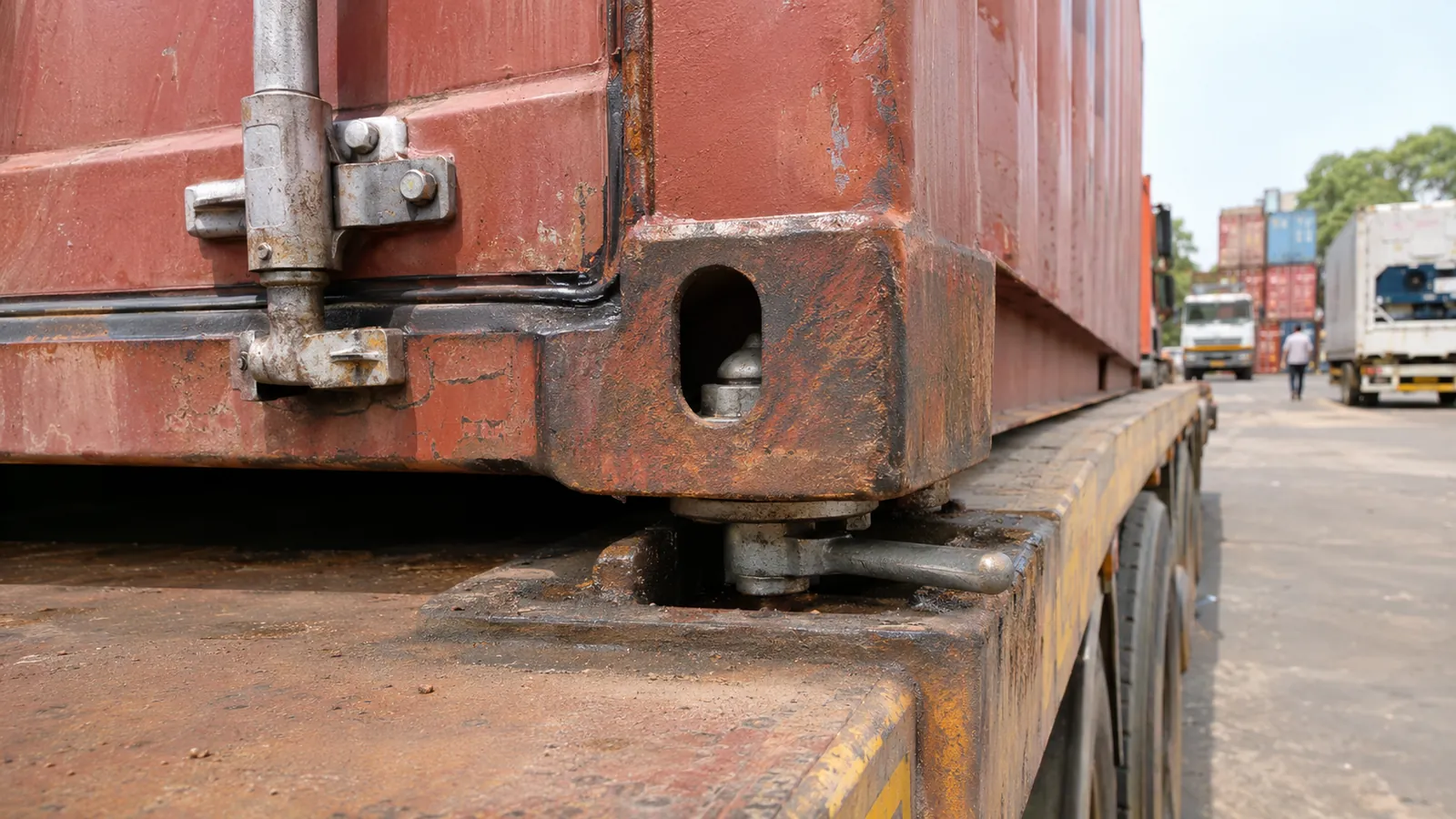
Corner casting dimensions (ISO 1161)
| Item | Figure | Where it comes from |
|---|---|---|
| Block size | 178 × 162 × 118 mm (≈ 7 × 6⅜ × 4⅝ in) | the usual size; an example in the 1984 edition, never a requirement |
| Oval hole on top | 124 × 63.5 mm (≈ 4⅞ × 2½ in), tolerance up to +1.5 mm | ISO 1161 |
| Hole on the side | 51 × 79.5 mm (≈ 2 × 3⅛ in), tolerance up to +1.5 mm | ISO 1161 drawing |
| Top plate, where the lock goes in | ≈ 28.5 mm thick | ISO 1161 drawing |
| Material | heat-treated cast steel: yield ≥ 275 MPa, tensile ≥ 480 MPa, 27 J impact at −20 °C | ISO 1161 |
| Mass | ≈ 11 kg | a maker's data sheet |
| How many | 8 (4 top, 4 bottom); 16 on a 45 ft | ISO 1161 |
ISO 1161 fixes the holes, strength and steel of corner fittings. The 178 × 162 × 118 mm block quoted by makers and traders comes from a non-mandatory annex of 1984, removed in 2016. ISO 1161:2026, a new edition, appeared on 16 October 2026.
Every fitting is cast for one corner: right-hand ones mirror left-hand ones, and bottom ones match top ones apart from the hole in the end face. Each carries its maker’s mark, a heat number and a certification stamp. On a 45 ft box, a second set of eight fittings at the 40 ft spacing lets it ride on 40 ft trailers and stack on 40 ft boxes (45 ft container).
What are a container’s corners called?
ISO 1161 says corner fittings; the trade mostly says corner castings. They are the eight cast blocks where the corner posts meet the top and bottom rails: cranes lift by the top four, twist locks grip the bottom four, and stacked boxes bear on one another through them.
What size twist lock fits a container?
Its head has to slip through the 124 × 63.5 mm hole before turning, so it is somewhat smaller, roughly 104 × 56 mm according to one encyclopedia. The exact sizes and strengths sit in an annex of ISO 3874 (handling and securing of containers) that we have not seen: ask the seller for the lock’s drawing and make sure it suits your box or trailer. On one Indian supplier’s listing, a cast semi-automatic lock weighs about 8 kg.
Where twist locks go: spacing on 20 ft and 40 ft trailers
| Length | Lengthwise, hole centre to hole centre | Crosswise | Largest allowed difference between diagonals |
|---|---|---|---|
| 10 ft | 2,787 mm | 2,259 mm | 10 mm |
| 20 ft | 5,853 mm | 2,259 mm | 13 mm |
| 30 ft | 8,918 mm | 2,259 mm | 16 mm |
| 40 ft | 11,985 mm | 2,259 mm | 19 mm |
| 45 ft | 13,509 mm | 2,259 mm | 19 mm |
From ISO 668:2020, Annex A (normative): distances between the centres of the fitting holes. You may see 11,986 mm for a 40 ft from some traders; the standard gives 11,985 mm.
These are the spacings at which trailers, rail wagons and ships mount their locks, so a 20 ft box sits on any 20 ft trailer. A 40 ft skeletal trailer from one Indian maker carries twelve locks: enough for one 40 ft box, a pair of 20 ft boxes, or a single 20 ft centred on the deck. Measure the two diagonals of a used box as well: a difference beyond the standard’s limit means a bent frame, and its locks may not engage.
Container twist lock types: manual, semi-automatic, automatic
| Kind | How it works |
|---|---|
| Manual | a handle turns it to lock and unlock |
| Semi-automatic (SAT) | locks itself when the upper box lands; unlocked by hand |
| Fully automatic (FAT) | locks and unlocks with nobody at the box |
| Midlock | where two 20 ft boxes share a 40 ft bay on board |
| Stacking cone | lines up two boxes without locking them |
| Trailer or wagon lock | fixed to the chassis at the corner positions |
| Weld-on socket | a steel base welded to a deck, trailer or foundation plate, taking a lock or the box itself |
ISO 3874 defines most of these. On ships, the IMO’s securing code wants few different types aboard, positive locking, no risk of a lock dropping out of its fitting, and preferably semi-automatic or automatic locks.
How strong is a twist lock?
A classification society’s guide to lashing gear asks a twist lock to survive at least 500 kN before breaking (about 51 tonnes force) and allows 299 kN in service. For comparison, one maker rates its fully automatic lock to break at 2,000 kN in compression, 500 kN in tension and 420 kN in shear. An Indian trailer-parts maker tests its trailer lock for a 35 tonne gross box on four locks. Securing gear is certified by classification societies on request; for a box on your own plot, get the lock’s rating, and a certificate if there is one, from the seller.
Which lock, and how many?
| Situation | What to use |
|---|---|
| At sea | semi-automatic or automatic locks between boxes: the shipping line’s job |
| On a trailer | the trailer’s locks under the four bottom corners, every one turned home before the truck sets off |
| Two boxes stacked on site | a twist lock or stacking cone at each of the four corners between them, so the upper box stays put |
| A box anchored to the ground | four weld-on sockets or plates on the foundation, with locks, is one method |
On anchoring: a 2023 circular from Singapore’s building authority (BCA) wants converted containers fixed to their foundation so wind and other loads reach the ground; how is left to the engineer, but corner fittings may not be cut. No Indian rule on anchoring containers turned up in our search; on a cyclone coast, a structural engineer will design to India’s wind code, IS 875 part 3. Supports under the corners: site preparation and unloading.
A padlock goes through the door handles, and some boxes have a welded lock box: how container doors work.
Twist lock prices in India
Container Bhav does not sell twist locks. For a rough idea, three Indian suppliers’ websites, read on 26 October 2026, asked:
| Lock | Asking price | Minimum order |
|---|---|---|
| Manual, stainless steel or chrome-plated mild steel | about ₹1,300 to ₹1,350 each | 20 |
| Mild steel trailer lock | about ₹600 each | 40 |
| Iron, lever or screw type | about ₹750 to ₹2,500 each | 1 to 100 |
| Cast semi-automatic | ₹4,300 each | 10 |
| Reconditioned manual | ₹2,450 each | 50 |
Asking prices, mostly marked approximate, with GST not stated, and not confirmed with the sellers. Most want orders of 10 to 50 pieces, while one box needs four.
Checking corner castings on a used box
Lift or stack a box and all its weight passes through the castings, so inspect each of the eight. Reject cracks near the holes, any weld repair to a casting, holes that are out of shape or worn too large, and deep rust where the casting joins the post and the rail. If the box is to be stacked or carried on a trailer, test a twist lock in one of the bottom fittings. For the rest of the inspection: inspecting a used container.
More size guides
Published 17 November 2026. Sources: ISO 1161 (1984, 2016 and 2026 editions), ISO 668:2020, ISO 3874:2017, the IMO's cargo stowage and securing code, a 2019 classification society guide, makers' data sheets and Singapore's 2023 building-authority circular. Prices: three Indian suppliers' websites, read on 26 October 2026.