Container cafe and cafeteria: cost, layout and licences
Two budgets, both our own estimates at the rates of India's Central Public Works Department (CPWD), with the box trucked from Mundra to Delhi NCR: about ₹4.2 to ₹4.6 lakh for a takeaway kiosk in a 20 ft container, and ₹8.4 to ₹8.6 lakh for a cafeteria with tables in a 40 ft high cube. Each covers the shell insulated and lined, the wiring, a granite counter cut for a sink, a hand basin and a shutter on the hatch. Kitchen equipment, the gas line, the hood and the work of cutting the openings are extra. Under the FSSAI rules in force since April 2026, a café turning over less than ₹1.5 crore registers rather than taking a licence.
Updated 17 Nov 2026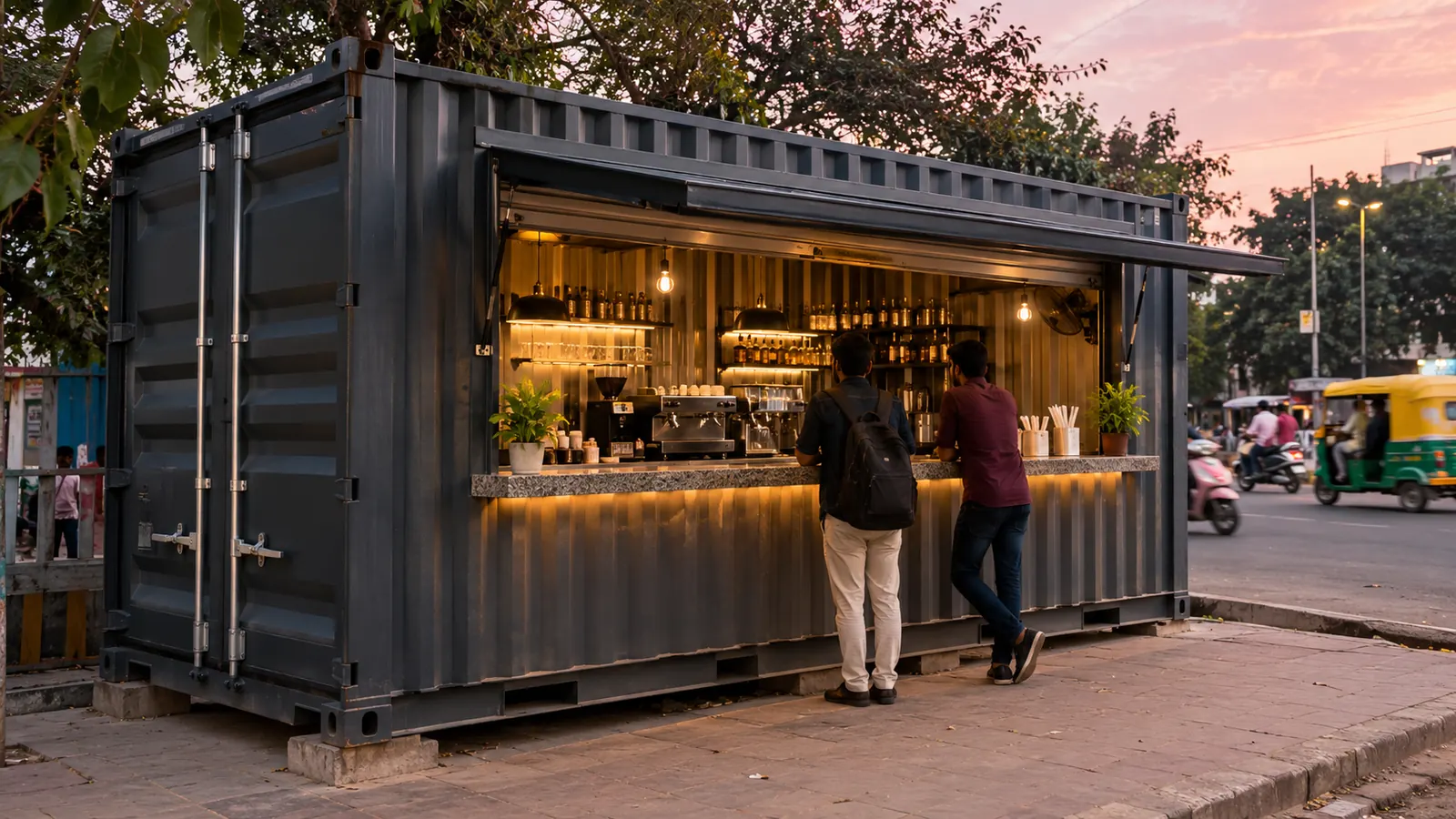
Container cafe price in India: two budgets
| Item | 20 ft café kiosk | 40 ft high cube café with seating | Basis |
|---|---|---|---|
| The box used box at its "from" price, GST included | ₹1,18,000 | ₹1,86,000 | our survey |
| Haulage Mundra → Delhi NCR, tariff silent on GST | ₹53,000 to ₹95,000 (estimated from the 40 ft rates) | ₹87,000 to ₹1,06,000 | published tariffs; our estimate from them (20 ft café kiosk) |
| Crane a day's hire, before GST, margin and travel | ₹5,000 | ₹5,000 | DSR 2023, hire charges, 0037 |
| Foundation 600 mm concrete cube piers; excavation not included | ₹7,000 (4 piers) | ₹10,000 (6 piers) | DSR 2023, 4.1.3 |
| Insulation XPS boards 50 mm thick on the walls and ceiling | ₹55,000 (53 m²) | ₹1,09,000 (106 m²) | DSR 2023, 26.7 and 26.8 |
| Inside lining gypsum boards 12.5 mm thick on steel studs, left unpainted | ₹72,000 (53 m²) | ₹1,44,000 (106 m²) | DSR 2023, 12.45.1 (a false-ceiling item) |
| Floor ceramic tiling; any underlay board over the plywood is extra | ₹15,000 (14 m²) | ₹31,000 (28 m²) | DSR 2023, 11.37 |
| Windows sliding uPVC windows, 1.2 × 1.2 m, without glass | ₹12,000 (1 window) | ₹48,000 (4 windows) | DSR 2023, 9.147.A1.1 |
| Inside doors 0.9 × 2.1 m flush doors | none | ₹4,000 (1 door) | DSR 2023, 9.21.2 |
| Serving hatch a rolling steel shutter on the serving opening | ₹11,000 (2.88 m²) | ₹11,000 (2.88 m²) | DSR 2023, 10.6.1 |
| Counter top polished granite 600 mm deep, edged and cut for the sink; base not included | ₹8,000 (2.4 m) | ₹11,000 (3.6 m) | DSR 2023, 8.2.3.2, 8.3.2 and 8.5 |
| Sink, basin and water stainless sink and drainboard with trap and waste, a hand basin, a supply pipe | ₹12,000 (1 sink, 1 basin, 8 m) | ₹13,000 (1 sink, 1 basin, 12 m) | DSR 2023, 17.10.1.1, 17.28.1.2, 17.69.2, 17.70.2, 17.7.2 and 18.7.1 |
| Power for appliances wired 25 A sockets, each on its own breaker | ₹10,000 (4 sockets, 15 m) | ₹16,000 (6 sockets, 24 m) | DSR (E&M) 2025, 1.57 and 1.5 |
| Wiring points for lights and fans | ₹9,000 (6 points) | ₹17,000 (12 points) | DSR (E&M) 2025, 1.3.1 |
| Sockets switched 6-pin sockets with circuit wiring | ₹5,000 (2 sockets, 8 m) | ₹9,000 (4 sockets, 16 m) | DSR (E&M) 2025, 1.32 and 1.7.2 |
| Board and earthing 6-way distribution board, breakers, 30 mA RCCB and pipe earthing | ₹12,000 (4 breakers) | ₹12,000 (6 breakers) | DSR (E&M) 2025, 2.3.1, 2.10.1, 2.14.1 and 5.1 |
| Air conditioning installed 1.5 ton split inverter units, 5-star | none | ₹87,000 (2 units) | DSR (E&M) 2025, 32.2.3 |
| Outside paint epoxy paint over primer | ₹18,000 (59 m²) | ₹35,000 (114 m²) | DSR 2023, 13.50.3 and 13.52.1 |
| Total of these items | ₹4.2 lakh to ₹4.6 lakh | ₹8.4 lakh to ₹8.6 lakh | our estimate |
Our estimate, rounded to ₹1,000, not a quote. Box: "from" price of the 15 November 2026 survey, GST added. Haulage: one shipping line's published 40 ft rates, GST unstated; a 20 ft is scaled from them. Fit-out: CPWD's Delhi schedules (civil 2023, electrical 2025), rates inclusive of GST and the contractor's margin; crane: its bare hire charge. Quantities follow one layout of ours (AC units, sinks and basins, pipe length, counter, hatch, sockets, points, windows and piers). Not counted: openings (the cut in the steel and its steel frame), the cabinet under the counter, glazing, the front door, washable paint or panels inside, lamps, the hood and its extractor, a geyser and a water tank, the grease trap with its drain to a sewer or soak pit, gas piping and cylinders, the espresso machine, fridge and other equipment, tables and chairs, extinguishers, excavation for the piers, grid and water connections, drawings, plan approval and licences.
Request container café quotes →
Three things move these totals the most:
| If… | What changes |
|---|---|
| the box comes from a yard near you | most of the haulage goes: ₹53,000 to ₹95,000 for the kiosk, ₹87,000 to ₹1,06,000 for the 40 ft (routes from other ports) |
| you pay the typical asking price, not the “from” price | add about ₹24,000 (20 ft) or about ₹38,000 (40 ft); how both prices are read |
| the converter lines with cheaper panels | the insulation and gypsum lines, about ₹1.3 lakh in the kiosk, come down |
The civil rates are CPWD’s of April 2023, and building costs have gone up since.
Which container for a café
| Café | Box | Listed from | Why this one |
|---|---|---|---|
| Kiosk | used 20 ft | ₹1,00,000 | the lowest-priced shell of the four; the box in our estimate |
| Kiosk with a cleaner face | one-trip 20 ft | ₹2,25,000 | fewer dents on the side customers see; only 5 sellers in our reading |
| Seated café | used 40 ft high cube | ₹1,58,000 | headroom left under a lined ceiling; the box in our estimate |
| Seated, lower roof | standard 40 ft | ₹1,60,000 | 30 cm less height inside |
Box prices are before GST.
Container cafe for sale at ₹2 lakh: what that price leaves out
Ads show “container cafés” from about ₹2 lakh. Most are new cabins of sheet or panels, priced ex-factory, so the truck, the crane, the piers and any AC are yours to add before you set them against our table. A cabin does have one real advantage: built 10 ft wide, it leaves staff more room behind the counter than a lined container’s 2.2 m. The container’s advantage is in its corners: a crane can pick it up and put it on a truck the day the café moves.
Can you start a café in 5 lakhs in a container?
| Plan | Our estimate | Within ₹5 lakh? |
|---|---|---|
| 20 ft kiosk, box hauled from Mundra | ₹4.2 to ₹4.6 lakh | the shell, yes; then little remains for framing the hatch, a door, a hood, an espresso machine, a fridge and connecting gas or power |
| 20 ft kiosk, box from a nearby yard | about ₹3.7 lakh, plus a short local delivery | a little more room for equipment |
| 40 ft café with seats | ₹8.4 to ₹8.6 lakh | no |
A 10 ft box does not help: in the 15 November 2026 reading, used 10 ft boxes were listed from ₹1,45,000 and used 20 ft ones from ₹1,00,000. Keep the rent or the price of the spot out of these sums.
Converted cafés on sale
No priced café passed our real-container test: what India sells as a container café is mostly a new cabin, 10 or 12 ft wide.
Among the priced listings of our surveys of 20 October 2026 and 22 October 2026, no café met our test (one unit priced, its use and length named, a title stating it began as a used or modified shipping container, nothing pointing to a prefab cabin); most units sold in India under that name are prefab kiosks or cabins, which we leave out.
What is a container café: real box or cabin?
A shipping container measures 2,438 mm (8 ft) across outside and 2,352 mm inside, has a CSC plate on its door and keeps the cast corner fittings a crane hooks into. Many cafés sold under the name are a mild-steel frame clad in panels, built new and often 10 or 12 ft wide. Both can serve coffee; only the first is priced on this site. How to tell them apart on site: container or porta cabin.
Container cafe design: a coffee shop kiosk and a seated café
| 20 ft kiosk | 40 ft high cube café | |
|---|---|---|
| Inside length | 5,900 mm (20 ft sizes) | 12,032 mm (high cube sizes) |
| Width once lined | about 2.2 m | about 2.2 m |
| Height before lining | 2,393 mm | 2,698 mm |
| Who goes where | a 600 mm granite counter with the sink under the hatch, the espresso machine and fridge on the opposite wall, about 1 m between them: two people can work | a walled kitchen of about 3 m at the far end, with its own door; the counter next to it; tables by the windows, on about 20 m² |
| Openings | a hatch of about 2.4 × 1.2 m on the side facing the street or the parking | the cargo doors as entrance, windows along both long sides |
Whatever the layout, corner posts, top rails and bottom rails stay uncut. A 2.4 m hatch takes a long piece out of a side wall that helps carry the box, so the opening gets a steel frame. In the 40 ft, put the kitchen and the gas at the end away from the guests’ door.
Licences for a container café
| What | The rule | For a small café |
|---|---|---|
| FSSAI | since 1 April 2026: a registration up to ₹1.5 crore of turnover, a state licence from ₹1.5 crore to ₹50 crore, a central licence above | a registration at ₹100 a year; registrations granted from April 2026 no longer expire while the fee is paid, and the 2026 amendment places temporary stalls and food trucks among petty food businesses |
| Hygiene, FSSAI Schedule 4 | washable floor, walls and ceiling; screens on openings; safe water on tap all day, with a tank where supply comes and goes; drains that work. For food service it adds a hood or chimney over the cooking and a basin for hands with hot and cold taps | give the gypsum board a washable paint, or panel the wall behind the counter; the food safety officer says which part of the schedule applies |
| GST on your sales | 5%, no input tax credit, unless the café is in a hotel charging over ₹7,500 a night (Notification 11/2017-Central Tax (Rate), entry 7(ii)) | |
| Your city | a trade or health licence, with rules that differ from one city to the next | within NDMC limits in New Delhi, the FSSAI or GST registration has counted as the health licence since February 2026 |
Cooking on gas or on electricity
Under the Gas Cylinders Rules 2016, LPG kept for your own use needs no licence up to 100 kg on the premises; five commercial cylinders of 19 kg add up to 95 kg. The cylinders must be stored covered, cool, dry and well aired, away from any flame.
Fire services then set their own terms. Mumbai’s, for a café with one cylinder connected and one spare:
- commercial cylinders of 20 kg at most, of a type approved by the Petroleum & Explosives Safety Organisation;
- a non-combustible platform over the cylinder, closed by perforated metal doors, at ground level and never in a basement;
- a gas detector of an approved type, two sand buckets, and a 9 kg ABC extinguisher for each 100 m²;
- above two cylinders, a separate cabin outside, 3 m from the building.
Mumbai lets the connected cylinder sit under the cooking platform. LPG is heavier than air, though, and leaked gas pools on the floor of a closed steel box: our advice is the spare cylinder outdoors, and the fire service’s word before the working one goes inside. An all-electric kitchen, with induction and an electric espresso machine, needs no cylinders at all, but it does need the sockets our estimate prices, on a commercial connection sized for them.
Seats, fire NOC and extinguishers
In Delhi, a restaurant seating over 50 counts as an assembly building and needs a fire NOC; a Delhi High Court judgment of April 2026 records the fire service’s position. A 40 ft box has about 28 m² inside, far too little for 50, but tables placed around it outdoors may be counted: ask how the service measures. Elsewhere the city’s fire service decides; since April 2026, the National Building Construction Standards (SP 7:2026) have replaced the 2016 National Building Code. The CPWD schedules have no rate for extinguishers, so our table leaves them out: have them added to the quote.
Water, drain and grease trap
The counter needs a tap, and its waste water a proper outlet rather than the ground. CPCB directions issued in July 2026 put restaurants of up to 100 seats in the White category, which has needed no consent to establish or to operate since October 2025. Two conditions remain: a grease and oil trap where the kitchen waste leaves, and any generator built to CPCB IV+ or burning gas. Tank, trap and the connection to a sewer or soak pit are site work; our table prices only the sink, the hand basin and their supply pipe.
Where the café can stand
In the rules we read (Delhi, Maharashtra, Mumbai, Chennai, Kerala), a café in a container on private land is simply a building. A café on a road or footpath needs the municipality’s permission. On land someone else runs, such as a mall, a campus, a highway stop or a fairground, that owner’s rules for food stalls come on top of the city’s; get them in writing. What we found city by city is in permission to place a container, and the box should sit level on piers under its corners (site preparation and unloading).
Keeping the heat out
A bare steel roof in full sun is the café’s first problem, for staff and for stock. Insulate it before the walls, shade it with a sheet roof or trees, and turn the hatch away from the afternoon sun. Both café estimates include insulation; only the seated 40 ft has air conditioning. Measured temperatures and condensation are on the container house page.
Container cafe makers: getting quotes you can compare
Makers and converters of container cafés seldom split their price into parts. Send each the same brief and ask for:
- Your plan: kiosk or seats, the size of the hatch, the counter, cooking on gas or on electricity.
- The shell: used or one-trip, with a photo of its CSC plate.
- A priced list set out like our table, GST on each line, plus what is not in it: hatch framing, entry door and glazing, hood, water heater, drain and grease trap, gas piping, equipment, extinguishers, haulage and crane.
- Papers and dates: who files the FSSAI registration and the city licences, how long the conversion and the delivery take, and a written warranty.
Container Bhav neither sells nor converts containers. Send the same brief as a quote request, and partner sellers covering your PIN code who do this work can reply.