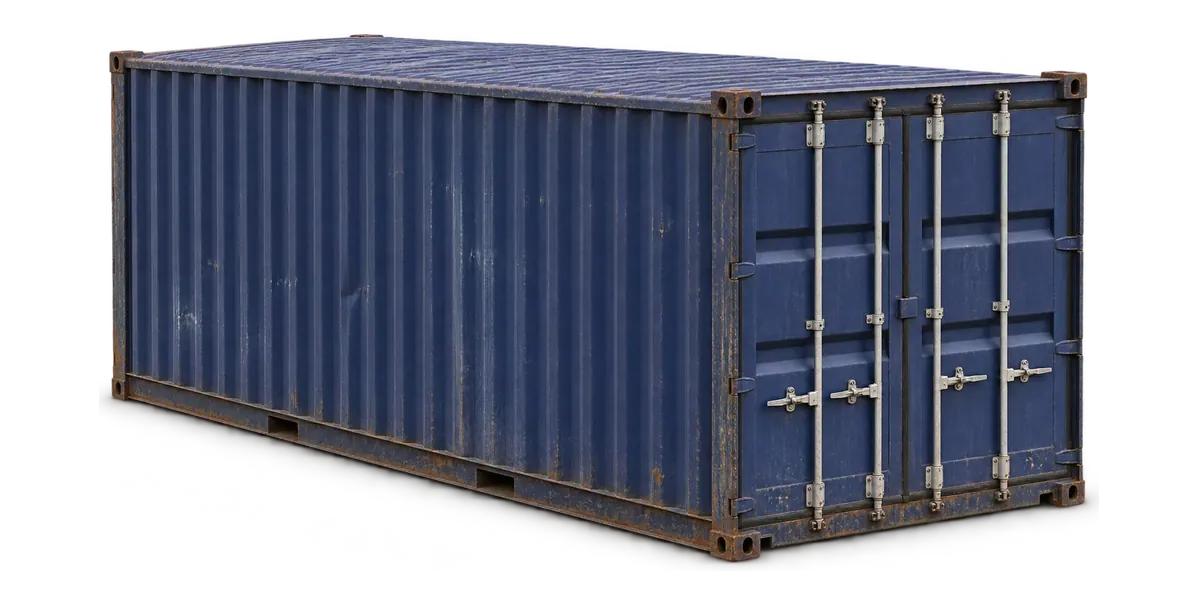
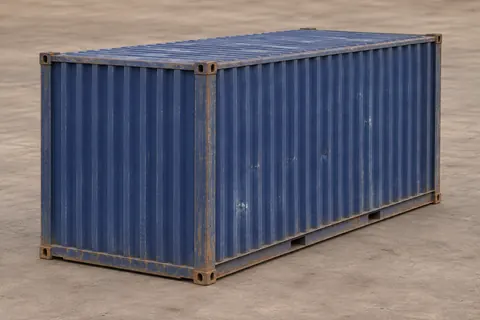
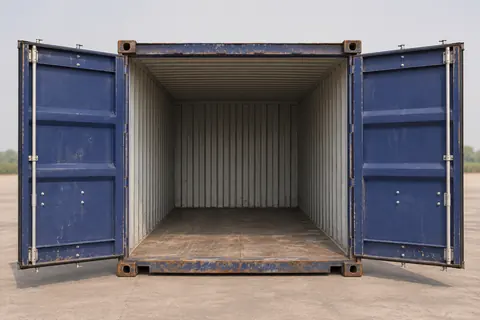
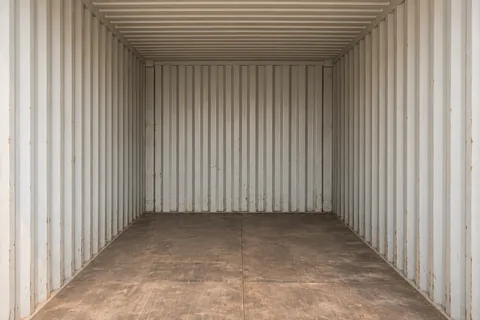
Used
20 ft shipping container, used (second hand)
6.06 × 2.44 × 2.59 m outside · 33.2 m³ inside · about 2,230 kg empty
No container had more sellers in our reading: on 15 November 2026, 172 listed a used 20 ft on IndiaMART and TradeIndia, at a typical ₹1,20,000 (₹1.2 lakh) for the box in their yard. It is the standard steel box of ISO type 22G1 after its years at sea, some still fit to sail and others for land only: 13.9 m² (149 sq ft) of floor closed by a pair of locking doors, on a footprint of 19′ 10½″ × 8′. Name the grade and your PIN code, and partner sellers can reply with a delivered price.
Asking for quotes
Send one request, get up to 5 delivered prices
-
One form, several yards
Describe the box and the place once. Partner sellers serving your PIN code can reply with a price that includes the truck to your site.
-
See where the low end is
On 15 November 2026, 172 sellers priced a used 20 ft shipping container. The middle half of them sat from ₹1,00,000 to ₹1,40,000, ₹40,000 apart. Put a few quotes next to each other and you see which end yours is at.
-
Sellers checked before they join
The platform that forwards requests checks each partner seller before its first request: GSTIN, company registration and PAN, insurance, its yard or stock, and how long it has traded or whom it has supplied. After a justified complaint, it takes the partner off.
Free, and you are not bound to anyone: the seller you pick invoices you and is paid directly. How it works
Used 20 ft container for sale: godown, shop or site office?
A used 20 ft is a room of 149 sq ft (13.9 m²), 19′ 4½″ long and 7′ 8½″ wide, windowless, with one pair of doors at one end. What you will do in that room decides the grade to ask for.
- As a godown, the box only has to stay dry and shut. The wind and water tight grade covers that, though few sellers write it in their listings (see the grade options above): name it in your request. Steel sweats on cool nights, so stand sacks and cartons on pallets, away from the walls.
- As a site office or a shop, people will spend the day inside: ask for cargo-worthy, with a floor that does not give underfoot. From floor to roof there is 2,393 mm (7′ 10″) before insulation and a ceiling take their share; the used 20 ft high cube has 305 mm more. Windows, a side door and wiring are the fabricator’s work: units already fitted are priced on container offices, container shops and container cafés, and container or porta cabin compares a lighter build.
- To ship goods or stack boxes, only a cargo-worthy box will do, with a CSC safety plate whose next examination date is still to come; a box cut open for windows or a door must be approved again before it ships.
Cargo-worthy
The grade to ask for when the box will ship, be stacked or have people working inside.
- Judged fit to carry cargo by whoever inspected it: there is no official definition.
- A frame, corner posts and cross-members without cracks or rust eaten through, and a floor that stays firm.
- Doors that shut and seal, with bars and rubbers in working order.
- Often a CSC plate with an examination still to come, though the grade and the plate are separate things.
- The paint of a working box: faded, scraped, rust spots on the surface.
Before paying, check: the CSC plate (next examination date or ACEP, and who examined the box), the plywood at the door end, and daylight from inside with the doors shut.
Wind and water tight
Keeps rain, wind and dust out; retired from sea service and sold for use on land.
- A grade sellers use, with no lessor's or official definition behind it.
- No holes: roof and walls keep rain, wind and dust outside.
- Dents, rust low on the walls and round the door frame, repairs you can see, and a floor that may be worn or patched.
- Often no valid CSC plate: fine for a godown on the ground, not for cargo at sea.
Before paying, check: the roof from above, where dents that hold water rust through first, the floor from inside, and daylight with the doors shut.
Grades are sellers' words, with no official definition behind them. What each grade covers · Checking a used container
Second hand 20 ft container loading: door first, then floor
Your largest item has to pass the door, which is smaller than the inside: the opening is 2,340 mm wide and 2,280 mm high (7′ 8″ × 7′ 6″), 113 mm lower than the roof inside, so a machine or a stack that would stand upright inside may still not pass.
On the 5,900 × 2,352 mm floor, one layer holds 11 Euro pallets (1,200 × 800 mm each), or 9 measuring 1,200 × 1,000 mm, with one row turned across the box and one along it: our arithmetic from the inside size, and a loader may fit them differently. A pallet truck or a forklift wears the plywood just inside the doors first, so look there before you pay.
Dimensions and weight
| What | Figure |
|---|---|
| ISO size-type code | 22G1 |
| Outside, L × W × H | 6,058 × 2,438 × 2,591 mm19′ 10½″ × 8′ × 8′ 6″ |
| Inside, L × W × H | 5,900 × 2,352 × 2,393 mm19′ 4½″ × 7′ 8½″ × 7′ 10″ |
| Door opening, W × H | 2,340 × 2,280 mm7′ 8″ × 7′ 6″ |
| Floor inside | 13.9 m²149 sq ft |
| Space inside | 33.2 m³1,172 cu ft |
| Empty weight (tare), range 2,120–2,350 kg | 2,230 kg |
| Load limit (typical) | 28,260 kg |
| Maximum gross | 30,480 or 32,500 kg, depending on the box |
Usual figures (median of 9 data sheets published by CMA CGM, Evergreen, Hapag-Lloyd, Maersk, MSC, ONE and ZIM, read on 20 October 2026), feet and inches to the nearest half inch. The tare and the maximum gross of each box are painted on its doors, and the maximum gross is stamped again on its CSC plate; a box rated higher can carry more: its maximum gross minus its tare. Every figure in feet, centimetres and millimetres: 20 feet container size.
Delivering a 20 foot shipping container: road, lift and base
Agree three things with the seller before you accept a delivered price:
- The road in. A truck carrying a container may stand up to 4.52 m tall under the motor vehicle rules: look for wires, branches and gate arches on the way, and for room to turn at your gate.
- The lift. The box itself is about 2,230 kg empty, between 2,120 and 2,350 kg depending on the maker’s sheet. It is lowered by a crane mounted on the truck, slid off a tilting bed, set down by a side-lifter, or lifted by a hydra hired for the day. On the CPWD schedule of 2023, a mobile crane, operator and fuel included, cost ₹5,050 for eight hours, plus GST, the hirer’s profit and travel to your site: a public rate, not a quote. The quote should say who brings the lift and who pays for it.
- The base. A level patch of at least 19′ 10½″ × 8′ (6,058 × 2,438 mm), a block or pier under each corner casting, and 1.2 m (4 ft) of clear ground in front of the doors, which swing outwards. Details in site preparation and unloading.
If the box is trucked in from another city, the delivered price estimate sketches the truck’s cost; either way, get the delivered figure in writing from each seller.
GST on a used 20 ft container: what the invoice should show
Treat a listed price as “GST unsaid” until the seller writes otherwise: 20 of the 24 exact-price listings for a used 20 ft that we read on 20 October 2026 said nothing either way. Added at 18% (HSN 8609, the rate since 22 September 2025), GST turns ₹1,00,000 into ₹1,18,000. Under the margin scheme, a dealer in used goods pays GST only on its own margin, and its invoice shows no tax you can set off: ask which of the two each quote uses before you compare them.
On the invoice, check three lines: the container number, as painted on the door; your own name (and GSTIN, if you claim input tax credit); and the seller’s GSTIN, which should bring up the same legal name when you search it on gst.gov.in. More in GST on shipping containers.
Used 20 ft container questions
Second hand 20 ft container price in India
About ₹1.2 lakh: on 15 November 2026, half of the 172 sellers asked ₹1,20,000 or less for a used 20 ft, and the middle half sat between ₹1,00,000 and ₹1,40,000. Single listings ran from ₹70,000 to ₹3,50,000: before sending an advance against a price far below that band, ask what it leaves out, the grade, the GST or the truck. Between our readings of 20 October 2026 and 15 November 2026, none of the 132 listings seen both times changed its price. Prices by grade and by area are on the 20 ft container price page.
Which colour will a used 20 ft be?
The colour of a box the seller already has. A used container keeps the paint it came with, often its last owner’s, unless the seller repaints it: tick a colour above as a preference, and each quote will say what is available. A repaint can be quoted as an extra.
How old is it, and is it a real container?
Ask the seller to photograph the CSC plate beside the container number on the door (four letters, then seven digits). The plate shows when the box was built, month and year, and either its next examination date or the letters ACEP. A cabin dressed up as a container has no such number; a box retired from sea service may have lost its plate, so judge it by its roof, floor and doors. Our reading does not record ages. The inspection guide lists what to look at in the yard or on a live video.
Is permission needed to place it on my land?
That depends on how long the box stays and what it becomes: a store kept a few months on a work site is treated differently from a permanent shop or room, and each state and town has its own rules. Permission to place a container sets out what we found.