Shipping container door dimensions, and how the doors work
Plan around 2,340 × 2,280 mm (2.34 × 2.28 m, 7′ 8″ × 7′ 6″): that is the door opening of a standard 20 ft or 40 ft container, and since it is lower than the inside, it decides what goes in. A high cube's door is taller, 2,585 mm (8′ 6″); a reefer's is narrower and a little lower than a dry box of the same height, 2,290 × 2,252 mm in 20 ft and 2,290 × 2,557 mm in a 40 ft high cube. These are medians of shipping lines' data sheets, which differ by up to about 2 cm on dry boxes and 10 cm on reefers.
Updated 17 Nov 2026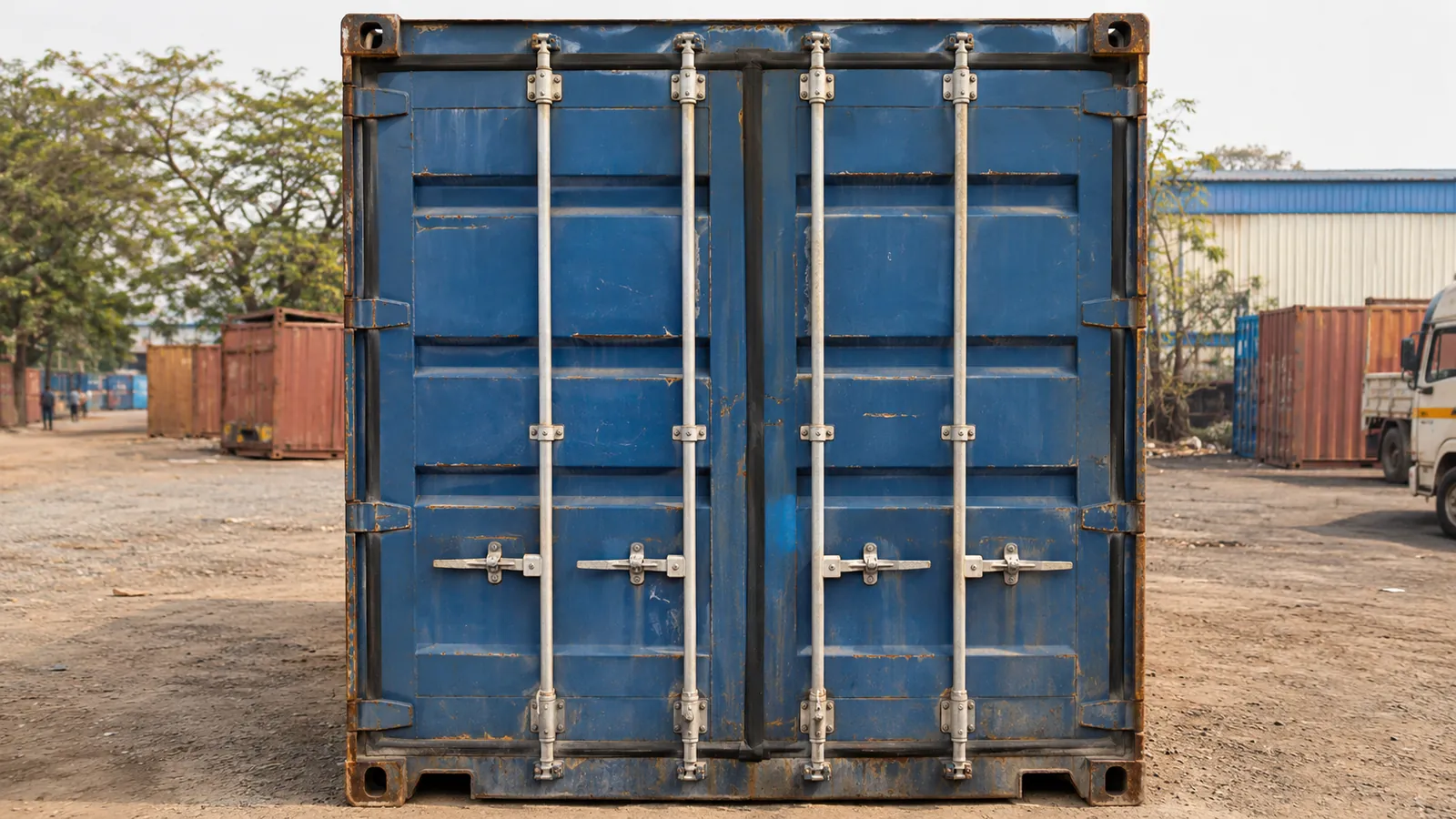
Container door opening dimensions, type by type
| Box | Opening (W × H) | Metres | Feet and inches | Spread across six lines | Height inside |
|---|---|---|---|---|---|
| 20 ft standard container | 2,340 × 2,280 mm | 2.34 × 2.28 m | 7′ 8″ × 7′ 6″ | 2,340–2,350 × 2,274–2,292 mm | 2,393 mm |
| 40 ft standard container | 2,340 × 2,280 mm | 2.34 × 2.28 m | 7′ 8″ × 7′ 6″ | 2,338–2,343 × 2,274–2,292 mm | 2,393 mm |
| 40 ft high cube container | 2,340 × 2,585 mm | 2.34 × 2.59 m | 7′ 8″ × 8′ 6″ | 2,338–2,343 × 2,577–2,597 mm | 2,698 mm |
| 20 ft reefer container | 2,290 × 2,252 mm | 2.29 × 2.25 m | 7′ 6″ × 7′ 4½″ | 2,290–2,294 × 2,212–2,266 mm | 2,180 mm |
| 40 ft high cube reefer container | 2,290 × 2,557 mm | 2.29 × 2.56 m | 7′ 6″ × 8′ 4½″ | 2,276–2,294 × 2,471–2,569 mm | 2,450 mm |
| 10 ft container | 2,340 × 2,280 mm | 2.34 × 2.28 m | 7′ 8″ × 7′ 6″ | — | 2,392 mm |
| 20 ft high cube container | 2,340 × 2,585 mm | 2.34 × 2.59 m | 7′ 8″ × 8′ 6″ | — | 2,698 mm |
| 45 ft high cube container | 2,340 × 2,585 mm | 2.34 × 2.59 m | 7′ 8″ × 8′ 6″ | — | 2,699 mm |
| 20 ft open top container | 2,340 × 2,280 mm | 2.34 × 2.28 m | 7′ 8″ × 7′ 6″ | 2,336–2,340 × 2,275–2,280 mm | 2,348 mm |
| 40 ft open top container | 2,340 × 2,278 mm | 2.34 × 2.28 m | 7′ 8″ × 7′ 5½″ | 2,336–2,340 × 2,275–2,280 mm | 2,348 mm |
| 40 ft high cube open top | 2,340 × 2,585 mm | 2.34 × 2.59 m | 7′ 8″ × 8′ 6″ | — | 2,653 mm |
| 20 ft open side container, end door | 2,170 × 2,169 mm | 2.17 × 2.17 m | 7′ 1½″ × 7′ 1½″ | — | 2,299 mm |
| 20 ft double door container | 2,342 × 2,280 mm | 2.34 × 2.28 m | 7′ 8″ × 7′ 6″ | — | 2,394 mm |
| 40 ft double door container | 2,340 × 2,280 mm | 2.34 × 2.28 m | 7′ 8″ × 7′ 6″ | — | 2,393 mm |
Door: median of the data sheets read on 20 October 2026, from shipping lines (makers, sellers and lessors for the 10 ft, open side and double door types; a single maker for the 20 ft high cube); feet and inches to the nearest half inch. Range: smallest and largest width and height across six lines' sheets read on 23 October 2026, where we compared them. One box may differ from the median: its own data sheet is the reference.
Boxes of one type are not identical. Six shipping lines’ sheets, set side by side, gave these spreads: width 2,340–2,350 mm and height 2,274–2,292 mm for a 20 ft door; height 2,577–2,597 mm for a 40 ft high cube; height 2,471–2,569 mm for a 40 ft high cube reefer. Some lines call their figures examples, not a promise for every box. When the margin is tight, get the data sheet of the box you will receive; a used box has none, so measure its door yourself, between the frames at the narrowest point and under the header. Flat racks have no doors at all.
What is the standard container door size?
On a standard box of any length, about 2,340 × 2,280 mm, or 234 × 228 cm. The width, 2,340 mm, is shared by every dry box, high cubes included. The 2,286 × 2,261 mm you may read elsewhere is the smallest opening ISO allows on an 8 ft 6 in box, not a real door’s size.
| Height of the box | Smallest ISO door (W × H) | Usual door (W × H) |
|---|---|---|
| Standard, 8 ft 6 in | 2,286 × 2,261 mm | 2,340 × 2,280 mm |
| High cube, 9 ft 6 in | 2,286 × 2,566 mm | 2,340 × 2,585 mm |
| 8 ft | 2,286 × 2,134 mm | not known: we read no sheet |
General purpose containers: smallest openings in ISO 668 and ISO 1496-1; usual door: median of shipping lines' sheets. Reefers fall outside these minimums and have narrower doors.
Door height: standard, high cube, reefer, 45 ft
| Box | Door height | Inside height | Note |
|---|---|---|---|
| 20 ft and 40 ft standard | 2,280 mm (7′ 6″) | 2,393 mm | 113 mm below the inside height |
| 20 ft and 40 ft high cube | 2,585 mm (8′ 6″) | 2,698 mm | 305 mm above a standard door |
| Reefer, 20 ft | 2,252 mm | 2,180 mm | insulated walls, floor and roof narrow the box; load only up to the red mark under the roof, which keeps a gap for cold air to reach the unit again: that mark, not the door, is the limit (reefer container) |
| Reefer, 40 ft high cube | 2,557 mm | 2,450 mm | the same |
| 45 ft | 2,585 mm, 2,340 mm wide | 2,699 mm | the door of a 40 ft high cube (45 ft container) |
40 HC container door height and width
Median height 2,585 mm (8′ 6″); between lines, anything from 2,577 to 2,597 mm; and 2,340 mm wide. Outside, the box is 2,896 mm (9′ 6″) tall against 2,591 mm for a standard one; everything else is in 40 HC container dimensions.
Why a door is lower than the inside
Above the doors, a steel beam, the rear header, joins the two corner posts, and it sits below the roof line. The data sheets put the opening 113 mm under the inside height of a standard box, and 113 mm under that of a high cube: a crate that clears the roof can still hit the header. Take the height of the load on its pallet, add what the forklift lifts it off the floor, and keep a margin. Forklifts sold as “container specification” have a low mast and overhead guard for work inside a box; ask the dealer what height its mast needs.
When the load will not go through
| Problem | Box to use |
|---|---|
| Taller than a standard door | a high cube, 305 mm more |
| Taller than any door, or lowered in by crane | an open top container: the header swings aside and the roof opens |
| Wider than the box | a flat rack, which has no side walls |
| Long, and forklifted in from the side | an open side container |
A car clears a standard door with width to spare: will a car fit in a 20 ft container.
How the doors close and lock
The two leaves at the door end each hang, on the maker’s specification we read, from four hinges and carry two locking bars. A bar is an upright steel rod turned by a handle; a cam at each end turns into a keeper on the frame, top and bottom. Double-lipped EPDM rubber gaskets seal each leaf against the frame and against the other leaf. Opened fully, a leaf swings round some 270° and lies flat against the side.
The right-hand leaf overlaps the left at the top, so it opens first and shuts last, the order customs rules for sealed transport insist on. The customs seal passes through the cam at the bottom of the right leaf’s inner locking bar; the handles take a padlock, and some boxes have a welded lock box shielding it.
Opening a container door, step by step
- Take the padlock or seal off the right-hand leaf.
- Lift both its handles out of their keepers and swing them round to release the cams.
- Pull that leaf open, then repeat on the left; fold both back against the sides for the full opening.
Stiff doors often mean the box is not level and its frame is twisted: put it on level supports (site preparation and unloading).
What is painted on a container door
| Marking | Where |
|---|---|
| Number and size-type code | usually high on the right leaf, towards the right |
| Tare, usually with maximum gross and payload | painted on a leaf |
| CSC safety approval plate | usually the left-hand leaf; the convention asks only for a readily visible place |
Compare the door’s number with the invoice before paying, and read the CSC plate; inspecting a used container explains it.
Doors at both ends?
Not on a standard 40 ft: its doors are at one end. A double door, or tunnel, container has a set at each end, so goods can go in one end and out the other, with openings of about 2,340 × 2,280 mm in 40 ft. Side doors along the length make an open side container. Sizes of both: container sizes.
Cutting a door for people into a container
A walk-in door turns a box into an office, shop or home, but it alters the structure:
- Leave the frame alone. A 2023 circular on container structures from Singapore’s Building and Construction Authority prohibits notching or cutting the top and bottom rails, corner fittings and corner posts, and keeps any opening to half the wall, steel-framed, which allows about 2.9 m in a 20 ft side. Have the fabricator weld a steel frame all round.
- The CSC approval lapses. Change the structure and the box’s safety approval under the CSC convention falls away until it is recertified, with new tests if asked for, and India’s classification society asks for recertification too. On the ground it can still serve as a room; it can no longer travel as a shipping container.
A room with a door may need your local body’s approval (permission to place a container); for worked conversions see office and shop containers.
Checking the doors of a used box
Five minutes at the door end tell you a lot about a used box:
- From inside, doors shut, in daylight: no light at the edges. Where light gets in, rain will.
- Gaskets: whole and supple, not torn or flattened.
- Each locking bar: its cams turn into the keepers at top and bottom.
- Hinges: none broken or seized.
- Both leaves: they swing right round and close without force.
More size guides
Published 17 November 2026. Door sizes: medians of the data sheets read on 20 October 2026, plus six shipping lines' sheets read on 23 October 2026. Standards and texts checked on 23 October 2026: ISO 668, ISO 1496-1, the CSC convention, a maker's specification, classification society notes, an industry marking guide, a forklift maker's advice, and Singapore's 2023 building-authority circular on container structures.