Open side container: sizes, side doors and uses
On an open side container, one long side is a row of folding doors that opens nearly from end to end, on top of the usual doors at one end, so a forklift can load pallets, machines and long goods from the side. On a 20 ft box the side opening runs 5.7–5.8 m by 2.15–2.19 m (length by height); the inside measures 5,898 × 2,287 × 2,299 mm, or 31 m³, and the empty box weighs about 3,190 kg, more than a standard one. High cube versions exist in 20 ft and 40 ft. None of our readings, the latest on 15 November 2026, found an ISO open side for sale by name. For scale, a used standard 20 ft was listed from ₹1,00,000 that day, a price one seller in four matched or undercut (request quotes from partner sellers).
Updated 17 Nov 2026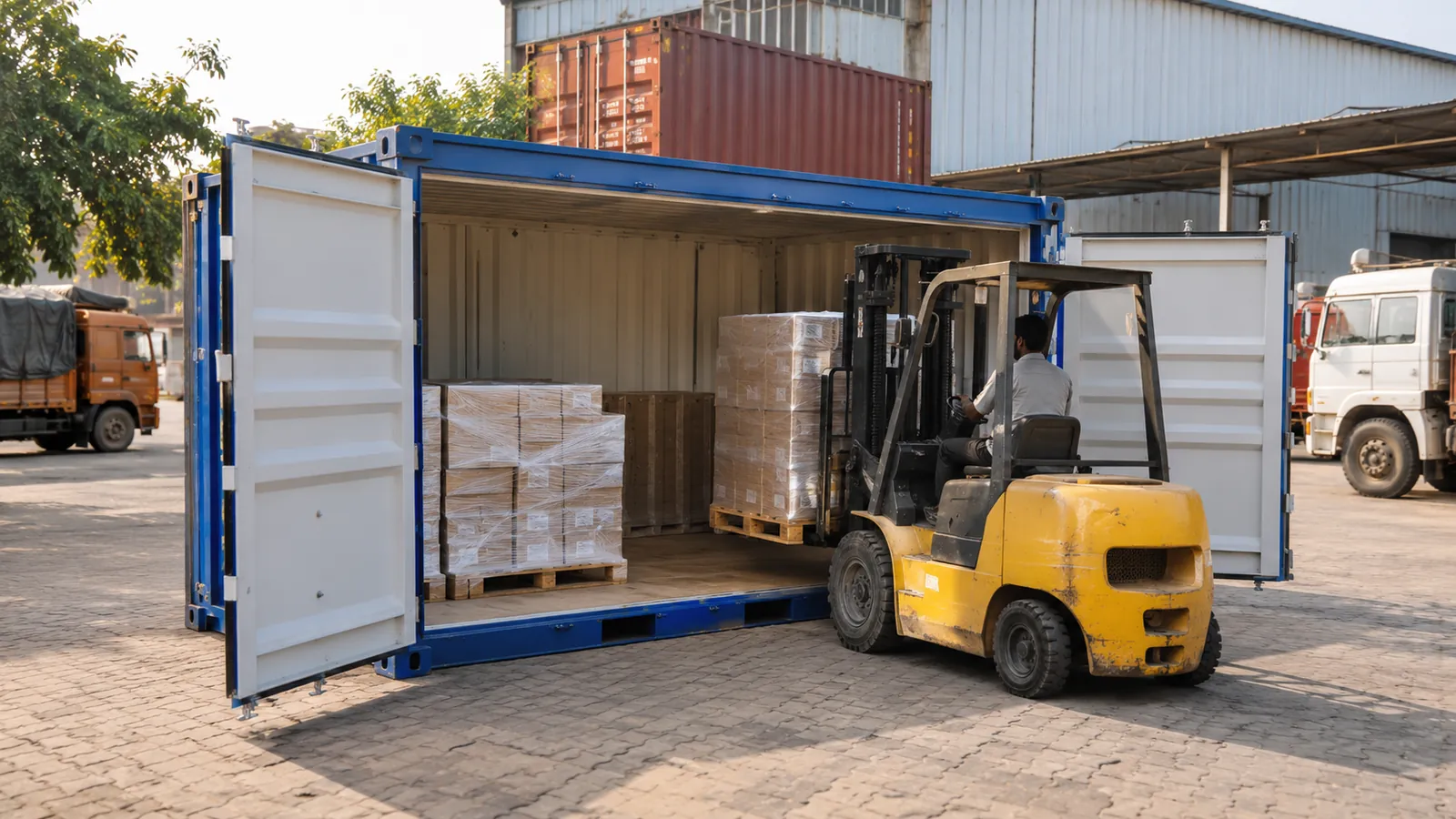
Open side container: what it is and how it is built
The long side is made of two pairs of bi-fold doors, four leaves in all. On one maker’s data sheet, the outer leaves swing back about 270° to rest against the side and the inner ones about 180°. Every pair locks with its own bars and seals with its own gaskets; a lock box protects the padlock, as on the double doors the box keeps at its end. Since no wall supports the floor edge on that side, a heavier bottom rail runs below the doors, and the frames take a little of the inside space.
One name, three kinds of box
Sellers use the words loosely, so ask which of these you are being offered:
| Name you may see | What it is |
|---|---|
| Full open side, side opening | one clear opening along the whole side |
| 40 ft high cube with a centre post | the roof rests on a fixed post halfway, leaving two side openings of roughly 20 ft each |
| Side door container | several sets of ordinary double doors along the side, with posts between them and a narrower clear opening; some sellers still call it “open side” |
Ask for the data sheet, the clear length of the side opening, and a photo of the side with every door open.
Open side container dimensions
20 ft open side
| 20 ft open side container | mm | cm | ft and in | m |
|---|---|---|---|---|
| Length, outside | 6,058 mm | 605.8 cm | 19′ 10½″ | 6.06 m |
| Width, outside | 2,438 mm | 243.8 cm | 8′ | 2.44 m |
| Height, outside | 2,591 mm | 259.1 cm | 8′ 6″ | 2.59 m |
| Length, inside | 5,898 mm | 589.8 cm | 19′ 4″ | 5.90 m |
| Width, inside | 2,287 mm | 228.7 cm | 7′ 6″ | 2.29 m |
| Height, inside | 2,299 mm | 229.9 cm | 7′ 6½″ | 2.30 m |
| End door, clear width | 2,170 mm | 217 cm | 7′ 1½″ | 2.17 m |
| End door, clear height | 2,169 mm | 216.9 cm | 7′ 1½″ | 2.17 m |
| Side opening, length by height | 5,702–5,846 × 2,154–2,189 mm (18′ 8½″–19′ 2″ × 7′ 1″–7′ 2″), per makers' sheets | |||
| Floor space | 13.5 m² (145 sq ft) | |||
| Capacity | 31 m³ (CBM) · 1,095 cu ft · 31,000 L | |||
| Tare (empty) | 3,190 kg (sheets: 3,000–3,200 kg) | |||
| Typical payload | 20,820 kg (≈ 21 t) | |||
| Gross rating | 24,000, 24,160 or 30,480 kg, varying by box | |||
Figures: median of 5 data sheets from makers, sellers and lessors, read on 20 October 2026; imperial sizes rounded to ½ inch. Each box shows its own tare and gross rating on its doors; the higher the rating, the bigger the payload (rating less tare).
Compared with a standard 20 ft container, the door frames and stronger floor make the inside 65 mm narrower and 94 mm lower, and the end door 170 mm narrower; it still holds 11 Euro pallets in a single layer, by our count. Before you choose a size, set your tallest pallet stack, on the forks, against the side opening: 2,154 to 2,189 mm high on a standard 20 ft, 2,480 to 2,494 mm on a 20 ft high cube. The inside is taller than the opening, so the opening is the figure that counts.
High cube open sides, 20 ft and 40 ft
| Figure (from the sheets listed below) | 20 ft high cube | 40 ft high cube |
|---|---|---|
| Inside (length, width, height) | 5,898 × 2,287 × 2,604 mm | about 12,032 × 2,287 × 2,461 mm |
| Side opening (length by height) | 5,702–5,846 × 2,480–2,494 mm (18′ 8½″–19′ 2″ × 8′ 1½″–8′ 2″) | about 11,836 × 2,300 mm (38′ 10″ × 7′ 6½″) |
| End door, W × H | 2,114–2,227 × 2,474–2,494 mm | about 2,226 × 2,348 mm |
| Tare | 3,180–3,600 kg | 5,170–5,920 kg |
| Volume | about 35 m³ | about 67 m³ |
| Maximum gross | 24,000 or 30,480 kg | 24,000 or 30,480 kg |
Where these figures come from: two makers’ sheets for the 20 ft high cube, plus a third maker for its inside height and tare. For the 40 ft high cube, a product page from one maker and sheets from two resellers, which disagree in places; tare and gross come from yet another maker, and the volume is our own calculation from the resellers’ inside sizes. No sheet we found describes a standard-height 40 ft open side.
On a 20 ft, the high cube gains about 300 mm of side-opening height. The 40 ft high cube opens about 11.8 m along its side, yet its sheets show only about 2.46 m inside, well under a closed high cube, so get the sheet of the box you are offered.
Weight and strength
Extra doors, frames and locks add weight. A 20 ft open side is about 3,190 kg empty, 960 kg above a standard 20 ft; a 40 ft high cube open side weighs 5.2 to 5.9 tonnes, while a closed one is about 3,865 kg. A 24,000 kg gross rating, not 30,480 kg, appears on several sheets; the CSC safety approval plate on each box has its own figure.
A side made of doors is not as strong as a corrugated wall. Even so, one maker certifies its 20 ft and 20 ft high cube open sides, through classification societies, to the same stacking and racking tests that ISO 1496-1 sets for closed general cargo boxes. A box built weaker carries a different code (next section).
Can it go to sea?
Built as an open side at the factory, with a CSC plate still in date? Then yes: the same maker clears its open sides for sea (on deck or below), road and rail. A closed box whose side was cut away later is a different case: it may not travel as a container again until it has been recertified.
The ISO code of an open side
The size-type code beside the container number shows whether a box opens at the side. In the ISO 6346 register:
| Code | Means |
|---|---|
| G2 | general cargo box fully open on one or both sides |
| G3 | general cargo box with partial side openings, such as side doors |
| GD, GG | G2 or G3 boxes rated for lower stacking or racking loads |
So expect 22G2 on a 20 ft full open side, 25G2 on a 20 ft high cube and 45G2 on a 40 ft high cube.
A 22G1 or 45G1, codes of closed boxes, may mean the side was cut open after building, although some sellers’ papers print G1 codes on boxes built as open sides: ask whether it was built that way, and see its CSC plate and approval papers. A box whose structure was altered loses its approval under the Convention for Safe Containers (as amended in 1991) until it is recertified, with new tests if required, which India’s classification society also expects. On the ground it still stores goods; at sea it is no longer a container. Codes for every size: size and type codes.
What open sides are used for
| Use | Why the side matters |
|---|---|
| Storage you reach from the front | nothing has to be unloaded to get at the back: handy for shop stock, spare parts, or farm sacks and implements |
| Pallets and long goods | a forklift puts pipes, steel sections, timber or rolls in sideways, rather than feeding them through the end |
| Site store | a contractor opens it at the start of the day and locks it at dusk, with tools, cement bags and long materials inside |
| Shop, café or stall | the open side becomes a counter or a stage (container shop, container café) |
In the monsoon, all those door joints are where water gets in: a box left outdoors needs gaskets in good shape.
How to open an open side container
- Open the padlock inside the lock box on the side doors.
- On the first pair of leaves, raise each locking-bar handle and turn it until both cams, top and bottom, come free.
- Pull the pair outwards, fold the inner leaf flat against the outer leaf, and walk both round until they rest on the container’s side. Repeat with the second pair.
- Closing is the same in reverse: fold, swing in, check that every bar has caught at both ends and that no gasket is pinched, then lock.
Each leaf on a 20 ft is about 1.4 m wide, so keep at least that much clear ground along the side, and far more if a forklift will load there: ask its driver how much turning room a pallet needs. Place the box with its opening side towards that ground, on level supports, since a twisted box jams its doors (site preparation and unloading). The end doors work like any container’s.
Open side container price and buying in India
None of our readings, the latest on 15 November 2026, listed an ISO open side by name. On 20 October, a used 40 ft high cube named “side door” in its specifications, yet the listing described a dry box and was silent about its doors; we count it as standard. Indian marketplaces do show “open side” containers, but the one we managed to open stated no clear condition, date or size, and its price was repeated on unrelated products from that site, so we leave it out. Among the Indian container factories we documented, none is shown building ISO open sides (shipping container manufacturers in India). An open side costs more to build than a standard box, so expect a higher asking price at the same age and condition.
| For comparison, 15 November 2026 | Listed from |
|---|---|
| Used standard 20 ft | ₹1,00,000 (typical ₹1,20,000) |
| Used 20 ft high cube | ₹1,25,000 |
| New or one-trip 20 ft | ₹2,25,000 |
| Used 40 ft | ₹1,60,000 |
| Used 40 ft high cube | ₹1,58,000 |
Asking prices before delivery; under 10 sellers, the figure is the middle of their prices; most listings leave GST unstated. Containers bear 18% GST under HSN heading 8609 (GST on shipping containers).
Use the button below for an open side quote, stating which size you need, standard 20 ft or a 20 or 40 ft high cube; partner sellers covering your PIN code reply with a delivered price if they can supply one. Get the size-type code from them, with a picture of the CSC plate. For a few months’ use only, ask for one on rent.
Request an open side container quote →
Checks before you buy
On top of the usual used container inspection:
- every leaf opens and closes freely and hangs straight;
- locking bars and cams engage top and bottom;
- gaskets are neither torn nor flattened;
- no forklift dents or rust along the heavy rail beneath the side doors and the edge of the floor above it;
- shut inside in daylight, no light shows at the joints.
Open side, open top or flat rack?
| Box | Loading | What you keep |
|---|---|---|
| Open side | from the side, by forklift | roof and walls: goods stay dry and locked |
| Open top | from above, by crane, for heavy or tall loads | walls; the roof is a tarpaulin |
| Flat rack | from the sides or above, for loads wider than a box | no side walls, no roof |
| Double door container | at one end, out the other | a normal closed box (container sizes) |
The 40 ft open side
What is a 40 ft open side container?
Mostly a high cube, with roughly 11.8 m of side that opens, either all at once or as two halves split by a centre post. Its sheets give 5.2 to 5.9 tonnes empty and about 2.46 m of inside height. We found fewer sheets for it than for the 20 ft, and their figures vary more.
Other types, and prices
Published 17 November 2026. Sizes and weights: the median of 5 data sheets from makers, sellers and lessors for the 20 ft, and makers' and resellers' sheets for the high cubes. Type codes: the ISO 6346 register. Checked on 23 October 2026. Prices: asking prices read on 15 November 2026.